Showing posts with label China. Show all posts

Wednesday, 22 July 2015

China - staying out of the news

A tumble in stock prices gives rise to more worries about China but it is not deserving of the bad press

News about China often hits the front pages as its swift rise is both scary and a source of economic salvation.  Stock markets in China have been making news recent due to a sharp selloff in shares.  The media are quick to jump on any potential hiccup in China’s rapid expansion due to its growing importance as a global economic superpower.  Yet, the peculiarities of stock markets in China mean that the spill over effects are likely to be limited even though the financial sector will continue to be a source for headlines in the future.

New to this game

Picking the right stocks and when to buy them is never easy but it is even trickier with China being a relative newcomer to trading shares.  The shorter the period of time over which shares have been traded, the more difficult it is to pin down what should be paid for stocks.  Many of the companies themselves are also still young and are still fighting a fierce battle with rivals for survival.  On top of this, the bulk of the investors in the Chinese markets are locals and have less experience in trading stock. 

The government further muddies the picture with its plans for liberalising the financial markets.  While fewer restrictions would be welcomed, the reforms create jitters due to the potential pace of change depending on the whims of its leaders.  Yet, the government regulations in themselves are part of the problem.  One issue is limits on how much banks can pay out in interest on savings accounts.  Starved of other places to put any spare cash, too many Chinese look to make money in domestic share markets which are ill equip to deal with the inflows.

While many eager investors have managed to sidestep the barriers, heavy regulation of the financial markets keeps out many more Chinese.  This has the effect of limiting any losses when the inevitable selloffs hit the stock markets.  In this way, the government ensures that the underlying economy is sheltered from any volatility in the stock markets.  Neither is the stock market much of a reflection of what is going on in the actual economy.  Chinese stock prices had stagnated for a long time prior to the recent ups and downs so it is unlikely that any bad news in the stock markets will be a prelude to trouble with the economy.

Watch this space

All this would not make the headlines if happening in any other emerging market but China is a big deal these days.  Its importance as the main global driver for economic growth makes outsiders nervous.  Its haphazard mix of free market and government control means that pessimists are quick to spot its faults.  But, just like with the patchy rules governing financial markets, the government has adapted in the past to stay on top of problems before things get out of hand.


The fear of market turmoil spilling over to society at large will continue to keep the Chinese on a cautious path to freeing up financial markets.  Over this time, China will continue to be plagued by a jumpy stock market as its investors grow used to the ups and downs of share prices.  Considering that even Western investors have not fully mastered this, the trials and tribulations of Chinese share prices will likely to be hitting headlines again many times in the future.  But, with government policy helping to stem the spread of any losses, it is not something that needs to cause too much worry yet.

Tuesday, 28 April 2015

China – Playing Catch Up

Many expect the Chinese economy to misbehave but it is more likely that China will grow out itself out of trouble

China is growing up in front of our eyes and there is an expectation that, like any adolescent, it will get into trouble before fulfilling its promise.  Naysayers predict that China’s growth spurt has left it with a number of issues that must be worked through before it can get any bigger.  Yet, China has a good head on its shoulders in the form of the Communist Party which will do all it can to keep the economy buoyant.  While the years of stellar growth are likely over, it need not mean that the Chinese economy will be held back.

Big trouble in (not so) little China?

The spectacular rate of growth achieved by China over the past decade could never continue forever.  Quite the opposite, the rapid expansion would have been harmful if it had been maintained and a slower pace of growth is actually a preferable outcome.  This is because much of the economic growth had been fuelled by investment – construction of new factories to sell cheap goods overseas along with the expansion of megacities in China to accommodate an influx of workers from the countryside. Normally, investment accounts for around 10% to 15% of GDP in most developed countries but reached 50% of GDP in China. 

This building frenzy could not continue especially when it is becoming more difficult to make money and some investments would be wasted on pointless projects.  It is the examples of this, empty apartment blocks and overly lavish public spending, that pessimists point to as evidence that China has gone too far.  With large amounts of bad debt expected to result from these poor investments, the financial sector is expected to take a big hit and drag the whole economy down with it.  The argument is basically that China has gotten too big for its boots and will need to shrink.

Growing up is never easy

Your Neighbourhood Economist would instead argue that China has a similar problem to what he had when he was growing up.  His mother would buy Your Neighbourhood Economist clothes that were too big for him in the knowledge that he would grow into them.  It is ungainly to be sporting oversized gear and this seems to be similar to the phase China is going through.  This is partly because China had been expanding so quickly that any investment needs to be put up in a hurry.  There is also the added complication of spending getting out of hand as regional politicians try to impress their bosses in the Communist Party.

Yet, China, like a much younger version of Your Neighbourhood Economist, still has a lot of growing to do.  Some of the ill-fitting parts of the Chinese economy may be put to better use as its citizen will continue to migrate toward the cities in search of work.  China has also learnt lessons from its investment binge with the central government shifting emphasis from economic growth to other benefits of greater wealth such as a cleaner environment and a more efficient bureaucracy.  Local officials are being brought into line through a crackdown on corruption and concentration of power within the Communist Party.

Along with changes to policy, the Chinese government also has the resources to deal with any past mistakes.  With both domestic savings and government reserves at high levels, there is plenty of money around if needed.  And, with an eye firmly fixed on keeping the economy growing, the Communist Party would not be as timid compared to Western governments in terms of stepping in and shoring up the banking sector if needed.  China is also moving away from investment as the driver of its economic growth and consumption is expected to pick up the slack (albeit with growth at a slower pace).

Growing while you watch

Your Neighbourhood Economist has seen the change in China with his own eyes.  In a visit 15 years ago, the Pudong area across the river in Shanghai seemed like a ghost town but one that had been freshly built with a scattering of skyscrapers.  Now, Pudong is anything but quiet and the pace at which new buildings continue to go up is testament to China’s growth.  It also shows that it you build it (in China at least), they will (still) come.

Wednesday, 14 May 2014

Growth in China: Steel vs Butter

Diverging fortunes of countries down under illustrate how China is changing

Trading with China can be like a roller coaster ride – lots of ups and downs without knowing what is coming next.  At a time when most of the global economy has been in the doldrums, tapping into the Chinese market has lifted the economies of a lucky few.  Australia and New Zealand are among the fortunate ones, but the diverging fortunes of these two countries highlight a shift in China’s development which will have profound effects for many others.

Riding out the twists and turns

Economic development of any country is never a smooth ride.  Growth in China has been bumpier than most with its economy jumping into life at a time when the world was becoming a much smaller place due to globalization.  The Chinese economy has expanded at an unprecedented pace due to its role as a manufacturing base built on access to foreign markets and funds from overseas. This has resulted in greater scarcity of many of the basic commodities extracted from or grown in the ground.

Countries fortunate enough to possess an abundance of natural resources, such as many in South America and Africa, gained a boost from high commodity prices at a time when the global economy is weak.  But these benefits are likely to be a temporary upturn with demand for commodities shifting as China develops.  The initial stages of the growth in China came through investment amid a building frenzy as firms rushed to put up factories to produce goods for exporting.  This has continued as the Chinese government has ramped up spending on infrastructure to counteract the weak global economy. 

The result has been a prolonged period of China sucking in resources such as iron ore, coal, and natural gas.  However, spending on investment was surging ahead at a pace which could not continue and has shown signs of an inevitable tailing off over the past year or so.  The government has instead eyed consumption as a new source of economic growth and as a means to keep the population happy.  This change in focus in China will be felt throughout the global economy.

Good and bad of changes in China

China was at the forefront of the mind of Your Neighbourhood Economist during a recent visit back home to New Zealand and a side trip to Australia.  Demand from China helped both countries to avoid a downward spiral following the global financial crisis, with Australia racking up an astounding 22 years without a recession.  Yet, it is Australia that is looking nervously at developments in China while New Zealand is looking to raise interest rates due to a booming export industry. 

The reason for concern among Australians is that its mining boom is starting to peter out.  Exports to China are still hitting record highs even as growth in the Chinese economy slows.  But investment in the mining industry has dropped off as commodity prices have fallen.  This leaves Australia in a tricky position as money from mining has pushed up the cost of living, resulting in wages that are too high to be competitive.  Employment may be starting to suffer - Your Neighbourhood Economist struggled to spot many Australians among the cabin crew on the Qantas flights to and from London.

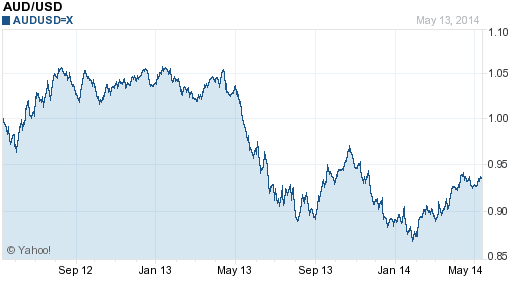
Two gauges of economic health augur tougher times ahead.  The central bank in Australia has pledged to keep interest rates at a record low of 2.5% for some time.  Along with this, the exchange rate for one Australian dollar has dropped below parity with the US dollar after having been worth more than its US counterpart in 2011 and 2012.  In contrast, New Zealand has seen its dollar continue to climb in value with the NZ central bank already having lifted interest rates twice to 3.0% in 2014.  It is milk and cheese that is driving the upturn in the New Zealand economy with the Chinese developing a taste for dairy products as their levels of wealth expand.

The shifting fortunes of Australia show that tapping into a growing Chinese economy has its downs as well as ups.  Despite this, New Zealand shows how change in China can be turned into a positive.  With China as one of the few bright spots in the global economy, this is a story that a lot of countries will be interested in.

Tuesday, 8 April 2014

China and its growing pains

The Chinese economy is treated like a problem child by the media but does not deserve its bad reputation

Growing pains have led to a lot of bad press recently for both China and Justin Bieber.  The development of both has been closely watched for any signs they are going off the rails.  Bieber has been much maligned for bad behaviour as he shakes off a boyish image.  China has been the driver of growth in the global economy but may not continue to fulfil this role.  Just like Bieber, much of the new stories on China are negative but China is different in that it does not deserve the harsh treatment in the press.

Big trouble in little China?

Like a spoilt kid growing up in front of the media, a developing economy can always expect a few troubles along the way.  Even more so when every step is analysed in detail as has been the case with the once-in-a-generation rise of a new superpower (China, not Justin Bieber).  The Chinese economy always seems to be on the cusp of a breakdown according to many experts.

The current concern with China is the high level of debt amid a surge in investment.  Some of the money has gone into projects that have not panned out as shown by empty housing apartments and dodgy infrastructure ventures.  The bulk of wayward spending tends to turn up in out-of-the-way places, such as the far-flung regions of China.  Here, both private and public investment is driven more by politics than by financial fundamentals.

Local politicians need a growing economy to please their masters in central government.  Large building projects are a convenient shortcut to achieve this and banks can be cajoled into lending to maintain their political connections.  Banks have limited room to move in China due to regulations which limit the level of interest rates on savings.  This encourages savers to stash their money in what is referred to as the “shadow banking sector”.  These offer higher returns on savings and provide firms who are shunned by banks access to loans.  But being outside the normal banking system means that this sector is harder to keep tabs on and influence through policy.

Bigger worries elsewhere in the world

Talk of politicians pushing projects and shady banks does not seem to bode well for China, but its banking sector is likely to be no worse than Western banks.  Banks in the US pushed dubious mortgages throughout the global financial system during their own lending binge.  At least any direct ramifications of a banking meltdown will be mostly contained within China.  Yet, such worries fail to take into consideration one crucial factor – the controlling influence that is the Chinese government.

The government in China has both the willingness and the ability to step in and shore up the banking sector if required.  The Chinese government intervened with a massive fiscal stimulus in 2008 and 2009 as the global economy slowed.  In comparison, most Western governments only managed a half-hearted response to the global financial crisis.  A sluggish economy with high unemployment is not something that the Chinese government would tolerate as its own existence would be under threat.

Another positive for China is that any potential problems with its banking sector are not symptomatic of bigger issues.  The financing for debt in China does not come from overseas but through China’s own reserves.  Neither is the surge in investment causing the overall economy to overheat as evidenced by subdued levels of inflation and a relatively low volume of imports.  The contrast with countries making up the “fragile five” could not be starker.  China is likely to ride out any bumps in the future as it develops but the same may not hold true for the turbulent career of Justin Bieber.

Monday, 27 January 2014

Insights from Asia: New Opium Needed

China has always been a tricky country to trade with but there are still ways of tapping into its growing wealth


Your Neighbourhood Economist has just returned from a four week trip around Asia which provided a few insights worth mentioning.  The first of these came during a layover in the bustling metropolis of Hong Kong with its unique mix of the old and new.  It was the history behind Hong Kong becoming a British colony that caught the attention of Your Neighbourhood Economist because it now seems as if history is repeating itself.

Similarities between Past and Present

In the 18th century China was beginning to open up to trade with European countries.  Goods from China including tea, silk, and porcelain were proving popular in Europe but there was nothing that Europeans merchants could tempt the Chinese into buying in return.  Thus, payment for Chinese goods was made in the form of silver which became a drain on finances.  As a solution, Britain increasingly relied on bringing opium into China but this created conflict between the two countries as importing opium into China was illegal.  The result was the Opium Wars which ended with a British victory and the island of Hong Kong being ceded to Britain by the Chinese as part of their surrender.

Move the clock forward a hundred and fifty years or so and some things are still the same.  China is again exporting goods that the West is keen to purchase – nowadays it is not luxuries but items produced using cheap Chinese labour.  Further similarities include the strong grip exerted by Chinese leaders over the management of the local economy.  Western firms are still eager to sell to Chinese consumers but their options for doing so are limited.  However, this is not because foreign companies have nothing with which to entice the Chinese.  This time the reason is that the Chinese government is acting to stall an invasion of multinational firms until local businesses become large enough to compete.

It makes sense for China to keep control over one of its main resources – a domestic consumer market with one billion enthusiastic participants.  Your Neighbourhood Economist would also advise the same policy of protecting up-and-coming Chinese firms from their battle-hardened Western rivals.  There are few things that China needs at its current state of economic development that it cannot provide for itself.  One of the handful of sectors where imports are important is commodities but China already gets most of its supplies from other emerging economies.

What to do differently this time around

All this has left Western governments scratching their heads with regard to selling to China.  Some countries such as Germany have prospered by selling machinery for Chinese firms to use in their factories.  But most other developed countries are struggling to find their own niche products to sell to China.  As a consequence, large numbers of container ships sail back to China mostly empty.  Opium is obviously no longer an option yet countries like Britain do need to find a way to tap into the growing wealth in China.

It is trade in services that is likely to be key.  Britain has lots of creative and business savvy firms specialising in the design and technology sectors.  Finance is one area which is still out of bounds in China but other sectors are open to outsiders.  Education, on the other hand, is a service that China is finding it hard to provide for itself in either sufficient quantity or quality.  Countries such as Britain can access Chinese wealth while also expanding its educated workforce either through Chinese students who study aboard or foreign schools set up in China.  In the future, higher paying service jobs rather than employment in declining industries such as manufacturing are more likely to provide the bulk of “good jobs”.  China will not always be so closed off or in need of education services but a focus on education seems like a winning formula in the meanwhile.


Monday, 29 July 2013

Good and Bad from Slowdown in China

When something is as inevitable as the growing dominance of China, the only option is to take the bad with the good.

It seems as if everyone is keen to know more about China.  The high level of interest is a result of both benefits and threats that China poses to the lives of us all.  China has an undue influence, be it the prices we pay for petrol or for running shoes, due to its dual role as a dominant consumer and producer in the global economy.  So slower economic growth in China and the reasons behind it will have effects that will ripple through the global economy.  But there will be good along with the bad and here is how it may play out.

Before starting on what might happen, it will be useful to look at the reason behind the slowdown.  The Chinese economy has reached a point of change in its development.  In the past, higher wages would prompt people employed in agriculture in rural China to move into the cities and work in factories.  This trend spurred the size of the economy to expand as these workers were being put to more economically productive uses compared to scratching out a living on small-scale farms. 

The first factories in China made basic goods such as clothing in the same way that the growth in textile factories was behind the Industrial Revolution in England around 200 years ago.  But as the economy has become more sophisticated, Chinese firms have invested massive amounts in new factories to produce more complex goods while the government has spent heavily on infrastructure.  But the driving force of growth came from the seemingly endless supply of cheap labour that would be put to use producing goods of higher and higher value.

But the end of economic growth fuelled by cheap labour and piles of investment seems near.  Rising wages in China are a sign that workers are proving tougher to find (refer to End of the end of the world).  Benefits from further investment are not as easy to come by considering the splurge in spending which lifted investment to around 50% of GDP compared to around 15% in the United States.  So the growth of a domestic consumer market as wages rise in China is seen as key as the next phase of economic development.  But the effects of this will not just be felt in China but across the globe. 

China has been the engine that is driving the meagre growth in the global economy.  Economies in places such as Germany and Australia have been kept perky by supplying machinery and minerals for the hungry Chinese economy.  Without this extra boost from China, the slowdown in the global economy would have been a lot worse even in countries which do not have links with China.  As such, a slowdown in China will be reflected in growth statistics across many other countries.  While the Chinese economy is still expected to expand by around 7% this year, the transformation of the Chinese economy from a manufacturing powerhouse to a consumer mecca is bound to be a bumpy ride and the effects of this on economic growth is still unclear (but there is good reason to be positive – see China brings out the Big Guns for more).

The economic rise of China has changed the shape of the global economy.  Everything from the price of coal to cows has been pushed upwards due to the seemingly insatiable appetite of the Chinese economy.  Much of the commodities have gone into providing the building blocks of the Chinese economy (steel girders and concrete slabs) and the fuel needed to drive the growing economy.  Less investment and slower growth will halt the upward rise in prices in some areas such as steel and other metals.  This will help lower construction costs all over the world and will be a blessing for places like Europe and the United States where investment has been weak. 

The slowdown in China is expected to provide other benefits for Western countries as well.  As shown by Chinese shoppers’ desire for luxury bags and shoes, demand for goods from overseas will increase as consumer demand picks up in China.  Whether it be producers of chocolate bars or fancy cars, there will be ample opportunities for Western firms to target Chinese consumers in the future as there will be strong demand for foreign goods until Chinese companies can build up their own brands.  The flipside of higher wages in China is that goods produced with a “Made in China” label will not be so cheap anymore.  Despite grumblings of firms faced with competition from exports, Chinese goods have been a boon for consumers in the West and have helped meagre pay packets go further.

For all of the good and bad, a slowdown is needed so that the Chinese economy does not implode under the weight of massive debts and reckless investment (for more detail, seeWhy China needs a slowdown).  The way forward will include some rocky patches but the rise of China is inevitable and will throw up challenges both within and beyond its borders.  Trying to fight it would be like trying to push back a rising tide – the only option is to make the most of it.

Tuesday, 23 July 2013

China brings out the big guns

Staying in control of a rampant economy is not easy but the Chinese government shows that it has the necessary firepower.

While investors follow the movements of central banks with one eye, their other eye would most likely be following the fortunes of China.  The rapid rate of expansion in the Chinese economy seen over the past couple of decades may be coming to an end with the era of cheap labour seemingly coming to an end.  But the centralized government in China has so far shown itself apt at managing the Chinese economy through its growing pains (see Why China need a slowdown? for related story).  Despite mounting concerns over economic growth in China, Your Neighbourhood Economist believes that the Chinese government has both the necessary firepower to point the economy in the right direction and the willingness to use it.

In its current state of development, the economy in China is still very much like the Wild West – lots of small firms battling it out in a gun fight to see who comes out on top.  This analogy does not hold so well when taking in consideration the giant state-owned companies which dominate parts of the economy or firms such as Huawei or Baidu who have already grown to the point where they are mostly above the fray. But China is a world away from having a few large firms dominate each industry as would be the case in most Western countries.  As such, competition is fiercer with big rewards awaiting those that can prosper.  The Wild West analogy also reflects the relative state of lawlessness in China where firms don’t have to worry as much about issues such as pollution, labour standards, and respect of intellectual property.

To add to the lawlessness, politics in China can seem at times as it is run by a bunch of gunslingers.  The higher levels of government are choreographed pieces of political theatre but politics at lower levels is more of a grubby battle.  Ambitious officials in regional government in China need to impress in terms of economic growth or social stability and can often become a law unto themselves whether it be taking land from farmers to build factories or getting local banks to splash out on loans to businesses. This incentive to create booming local economies can act against central government diktats even though both levels of government are controlled by the communist party. 

Banks themselves have also managed to avoid the rule of law and operate with a degree of impunity.  The government sets maximum rates for savers and minimum rates for borrowers with a big gap inbetween to help banks generate a profit.  This suits the major banks which are government owned but savers miss out due to meagre returns on any cash stashed away.  But banks keen to attract more deposits have come up with schemes to offer higher pay outs for investors and this extra cash has enabled the banks to lend even more.

The relative autonomy of local politicians and banks in China has fuelled a lending binge that has gone a bit out of control.  The ratio of debt to GDP has reached 200% which is well past the point when people start worrying.  The leaders in China have tried a softer approach such as signalling their disapproval but to little effect.  But the Chinese government has never shied away from stepping on toes and decided to bring out some big guns to put pay to the wayward banks.  At a time of year when all of the scheming by banks had left them short of cash, the central bank in China left banks to sort the cash shortfall out themselves despite typically acting as a source of funds in the past. The lack of money resulted in banks scrambling for cash and interest rates surged upward briefly topping 25% in the middle of June (search for SHIBOR spike for more info).  This created turmoil among Chinese banks, for whom not only were the central bank’s actions a complete surprise but the intentions behind the move were also a mystery. 

Some interpreted the actions of the central bank to be a brutal way of knocking banks into line but it will probably prove to be more fruitful than the policies of the their Western counterparts.  Whereas other central banks have struggled to maintain stability (see Why is the economy still stuck in a rut? for more on the limited influence of monetary policy elsewhere), China’s central bank is not afraid of drastic action to shake things up even if it will result in a bit of temporary chaos.  The spike in interest rates is expected to have put many banks into trouble but will be good for the banking system as a whole if it helps to reign in lending.  Officials in China are conscious of the need to keep the economy growing so that the Communist Party can maintain its grip on power.  It is this focus on the big picture rather than the fickle concerns of voters that will keep the Communists in power in what is destined to soon be the world’s largest capitalist economy.


Friday, 8 February 2013

The danger of positive thinking

With global stock markets in the midst of a major mood swing at the beginning of 2013, a new found optimism brings its own perils.

It is as if the market as a whole decided to focus on the positives as its New Year’s resolution.  Global stock markets have taken off in January 2013 as investors have shrugged off the worries that had weighed down on stock prices in 2012.  But while chronic pessimism has plagued markets over the past few years, the opposite has been the case in the New Year as stock prices have rebounded to levels which are tough to justify amid weak growth in the global economy.  So even though too much negativity has wreaked havoc in the markets, unfounded optimism can bring its own problems.

The prices of shares had been due for a rebound.  Investors had been on a knife edge with the potential for disaster seemingly around every corner as leaders in Europe dithered during the Eurozone crisis, politicians stepped up to the edge of the fiscal cliff in the United States, and the economy in China slowing during changes at the top of the Communist Party.  But along with Mayan predictions of the end of the world, all major catastrophes were averted in 2012 and this prompted a change of heart after investors returned from their holidays. 

Bonds are the typical haven for investors in times of woe and the past few years followed this pattern with investors having snapped up the bonds of prudent countries that have manageable debt levels even though interest rates have been below two percent.  Yet, bond prices have risen so high that further gains are not likely, but there were few other attractive investments at the time. And, as 2012 drew to a close, investors aching for higher returns had already shifted from the safer government bonds into the bonds of previously shunned countries such as Spain and Italy as well as corporate bonds. 

The new signs of life in the stock market tempted many into believing that the time was right to take on more risk and cash in their bonds to place a bet that improvements in the global economy would pick up pace in 2013.  This scenario has prompted talk of a “great rotation” as a swing in sentiment prompts investors into moving money from bonds in stocks.  The continued printing of money by central banks to shore up ailing economies has also helped to buoy the spirits of investors.  This all suggests an abundance of cash which will be heading into the stock market.  Yet, although it makes for a nice story to help prop up share prices, it may just turn out to be a fairy tale.

One of the main sticking points is that, while share prices have rebounded, the outlook for the global economy is still grim.  Higher share prices need to be backed up by companies generating larger profits and this cannot happen until the global economy has regained more vigour.  While an economic armageddon has seemingly been avoided in 2012, growth in the global economy will remain sluggish as high levels of government debt in many countries are trimmed back over years of austerity (for more details about Europe in this context, see Both Good and Bad News for Europe).  

Despite the holes in the story of the “great rotation”, many investors have been keen to believe in a new beginning.  Even the temptation of dubious scenarios can draw buyers back to the market due to concerns about being left behind if the market rebounds.  Investors also buy on expectations of what will happen in the future rather than based on the here and now so a dramatic improvement in economic growth in the following 12 months could prove that now is the right time to buy.  But with many having suffered heavy losses as share prices plummeted during the global financial crisis, a false dawn will do little to reassure investors that it is safe to return to the market.  An overly inflated stock market will also create a conundrum for central bankers and may prompt them to tighten up monetary policy while the economic recovery is still tenuous.  So here’s hoping that investors wake up from the pipe dream of soaring share prices before it turns into a nightmare.  

Thursday, 11 October 2012

The end of the end of the world

For manufacturing firms in developed countries such as the United States and the United Kingdom, the rise of China as a manufacturing base was seen as the end of the world.  With a seemingly endless supply of low-wage and diligent Chinese workers, manufactures elsewhere have been forced out of business and those that survived retreated to more high-tech products which were still beyond the reach of Chinese firms.  But the end is no longer nigh.  The bountiful supply of cheap labour has dried up and wages in China are rising along with demands for better working conditions.  Not only does this suggest the end of Armageddon for manufactures in developed countries but may also open up new business opportunities.

The industrialization of any economy whether it be Britain during the industrial revolution in the eighteenth century or modern day China involves the mass migration of workers from the agricultural sector into manufacturing.  The increase in productivity (the ability for workers to produce more in the same amount of time) generates a surge in wealth which typically first goes mostly to the owners of factories employing the cheap labour.  But there comes a point in time when the supply of workers from the countryside starts to fall off and firms have to compete more to keep workers which results in wages starting to rise.  This is crucial for the formation of a consumer society as workers gain spare cash to spend.  This is where China is positioned at the moment and it is a trend that is likely to pick up in the future. 

Along with the typical momentum involved with industrialization, demography is another factor that is adding to the upward pressure on wages.  Population growth is slow due to China’s one-child policy which limits the available pool of labour.  With most families only having the one child, parents are investing more in the education of their single progeny and this combined with the bright prospects for the Chinese economy mean that younger workers are aspiring to more than menial factory jobs.  The trade-off is that higher wages are required to attract and maintain employees.  

Rising wages are a boon for China as its new-found wealth begins to be dispersed to its citizens to a greater degree.  And higher pay for Chinese workers also offers some respite for competing firms - both in other low-wage countries and in developed economies.  Wages are now lower in other countries in Asia such as Vietnam and Cambodia.  This will attract factories to move there and help spread the benefits of industrialization. 

But a mass exodus from China is not expected.  China provides not only cheap labour but excellent transport links and suppliers of various components required for manufacturing which have been developed as China has become a key cog in the global supply chain.  Instead, China is expected to increasing replace workers with machines as pay rates increase further.  This will also be accompanied with a shift toward more high-tech products.  But this opens up the chance for big pay-offs for Western firms that can supply the machinery to Chinese factories as well as companies that can tap into the growing consumer market as employees get paid more. 

Doing business in China will still continue to present difficulties.  The Chinese government is doing its best to control the economy during this unprecedented surge in growth (for details, see Why China needs a slowdown) but that is like trying to steer the proverbial bull through a china shop.  The politics generated by a rise of China as a new power can also be problematic such as in the case of Japanese firms struggling with a nationalistic backlash over issues dating from over 60 years ago.  The growing pains involved in the coming of age of a country of 1.3 billion were never going to be easy but changes in the economy in China are offering up a new wealth of opportunities.

Friday, 5 October 2012

Why China needs a slowdown

The rise of China will be the most momentous shift in economic power of a generation and it is only a matter of time until China will be the largest economy in the world.  For a long time, the concerns regarding China have been over its relentless rise and how its insatiable appetite for raw materials has pushed up commodity prices.  But the world economy has become dependent on China as an engine of growth as economies in Europe and elsewhere stumble.  So the worry now is not about China expanding too fast but China not expanding fast enough as sluggish global demand begins to hurt China’s economy and the Chinese government is not acting to maintain the previous hectic rate of economic growth.

As a capitalist economy with a communist government, China has the best of both worlds.  Rampant entrepreneurism, which Your Neighbourhood Economist has always associated with Chinese people (positive racial stereotyping?), has resulted in wealth creation on a massive scale and dragged millions out of poverty.  Yet, the communist government maintains a level of control over the economy to help the country through a period of unprecedented growth.  As such, the government stepped in when the global financial crisis hit in 2008 with a colossal economic stimulus worth 16% of GDP over two years.  It may seem a strange notion for a communist government to be propping up a capitalist economy but it is the best way for the communists to provide higher income for its citizens and maintain their grip on power.  And a strong central government helps to keep much of the messy politics out of the way (for an example of politics getting in the way - One step forward and two steps backwards)

Yet, as the global economy weakens, China itself is in the midst of a significant economic slowdown but the government has held back from throwing its full weight behind another economic rescue mission.  The Chinese government has the capacity for further action as it does not have the debt of governments in other large economies.  Punters in the media have suggested that it is the change of the top government posts that has resulted in the leaders in China being distracted.  Others have pointed to the possibility that more of a stimulus would not have any further effect.  But Your Neighbourhood Economist would argue that the Chinese government is smarter than that and still has the capacity to generate growth in the economy.

It is not that the Chinese economy wouldn't get a boost from more stimulus but that such measures would create more problems than it would solve.  The economy in China is like a weightlifter on steroids – more steroids would typically help to lift heavier weights but too much can cause severe damage.  Investment is the steroids that have been driving the Chinese economy.  Investment is typically what fuels any economic expansion.  Companies build factories and shops if there are products to make and sell but this will only happen if consumers have enough money to buy the goods.  So investment surges when an economy is booming but companies will stop investing if times turn bad.

Companies in China not only provide goods and services for the 1 billion people that live in China but also export products for retailers across the globe.  As such, investment in China has reached unprecedented levels - around 50% of GDP compared to around 15% in the United States.   Much of the stimulus package in 2008 went toward spending on infrastructure and was combined with lower interest rates and increased lending by state-owned banks.  A bit more of the same has been tried in 2012 but without the same fervour. 

The leaders in China could try more of the same but a further boost to investment may result in one shot of steroids too many.  That is not to say that it would not have an effect but rather than the effect would be to exacerbate imbalances in the Chinese economy.  Investment that outpaces growth in the economy risks not only being a waste of money but distorting the development of the economy.  Excessive spending to build factories which end up producing goods that no one wants will result in bad debts.  Spending on infrastructure is another possible form of investing but this also needs to expand along with a growing economy so as to go to areas where it is actually required rather than roads to nowhere.

Considering that global banking system got in trouble following a period of debt fuelled expansion, Your Neighbourhood Economist hopes that lessons have been learnt and that the Chinese economy is not pushed to expand too rapidly.  But only time will tell – stay posted.