Showing posts with label Currency Markets. Show all posts

Wednesday, 24 September 2014

Euro as the new Deutsche Mark

Germany practically controls the euro as if it were its own currency but it would gain more being less in charge

Being a big fish in a small pond can have its benefits as Germany is discovering in its dealing with Europe.  Its powerhouse economy means that Germany was one of the few countries left standing after the Eurozone crisis.  Germany has used this position of strength to turn the euro into its own de-facto currency.  It dominates the decisions over monetary policy and has influences spending decisions by politicians outside of its borders.  This level of control is alienating many others in Europe while still being insufficient to keep Germans happy.  As a result, more could be gained by Germany trading away its power to secure a brighter future for Europe as a whole.

Benefits of being the boss

Control over monetary policy is not something that Germany fought for but it came as a by-product of the Eurozone crisis that hobbled the other powers in Europe.  More prudent management of government finances meant that the government has less debt and the economy has been resilient due in part to its exporting prowess.  This left its Chancellor, Angela Merkel, as one of the few politicians who is backed by voters and in a strong position to dominate European politics.

It has allowed Germany to impose its own policy measures over the Eurozone.  Germany has set the tone regarding austerity as well as its concerns over inflation limiting the scope of monetary policy.  Countries such as Spain and Italy would benefit in the short term from more government spending and looser monetary policy.  But Germany has pushed for a range of policies which are a better fit for its own economy than others in Europe where the shortfall in demand is more pronounced.  The aim is to bring others into line in terms of implementing reforms which would improve the outlook for Europe in the future.

Along with setting policies, being the boss of a widely used currency comes with a host of benefits.  For starters, investors looking for the safest place to park their euros will choose Germany over other European countries and this keep down interest rates in Germany.  Worries about a sluggish economy in Europe are a further boost to Germany by keeping the value of the euro weak.  The euro is both too strong considering the economic circumstances of many of the countries in Europe but considerably below what a truly German currency (a new Deutsche Mark) could be valued at. 

Getting more from less

As is often the case, its power has become like a poisoned chalice.  Not only is Germany out of tune with many of its neighbours but the euro is also increasingly unpopular at home.  The rapid rise of an anti-euro party in Germany (called the Alternative for Germany party) suggests that there are many Germans who feel as if they are getting a raw deal from being part of the Eurozone.  This party joins a growing list of populist parties in Europe worried about the level of integration needed to maintain the euro. 


If a position of strength does not come with many rewards, sometimes more can be gained from giving power away.  Germany could soften its strict stance on fiscal and monetary policy as a trade for more reforms in other countries.  This bargain would help deal with the short-term issues of a weak economy needing stimulus as well as concerns about the prospects for Europe over the long term.  Compromise also seems more likely now that deflation is a growing threat and the German economy itself is flagging.  It is time for Germany to cash in now as it may be too late if the situation in Europe gets worse. 

Tuesday, 1 July 2014

Interest Rate Hike – Easy on the Brakes

The Bank of England threatens to be too heavy on the brakes with higher interest rates and the economic recovery may stall as a result

Tinkering with complex machinery is tricky as changing one thing may have unintended consequences elsewhere.  This also applies to the economy.  The prospect of having to raise interest rates at a time when the economic recovery is still fragile is daunting enough.  Yet, there is a number of moving parts of an economy linked with interest rates which could throw an extra spanner in the works – one concern is that higher interest rates will push up the currency and hurt exporting firms.  This may push central banks to use other monetary policy tools to bide their time.

Complicated piece of machinery

What we refer to as the economy is the accumulation of an incredibly intricate multitude of monetary transactions in which we all are a small part.  In comparison, monetary policy is rather basic relying mainly on the lever of interest rates with extra bells and whistles, such as quantitative easing, added only when needed.  Monetary policy has been exceptionally loose but has still struggled to get the economy moving again.  These expansive polices cannot stay in place for ever and there are growing calls for interest rates to be raised off record lows. 

Interest rates normally affect the economy through the costs involved with taking out a loan.  But this is not the only route of influence.  One example is how higher interest rates will attract in money due to a higher pay-out for savings and this extra cash coming into the economy will push up the value of the currency.  A strengthening currency will adversely affect firms exporting to other countries as prices for their goods typically must rise and this risks putting them at a disadvantage relative to competitors. 

The potential for this is larger when one country moves to tighten its monetary ahead of its peers.  Such is the predicament facing the UK as the Bank of England contemplates the possibility of raising interest rates sometime in the next six to twelve months.  The mere expectation of this has propelled the pound higher relative to other currencies and may put further upward pressure on the pound if interest rates are predicted to rise faster than elsewhere. 

This problem comes about due to the freedom of money to chase around the globe after the best return.  Financial firms have made of most of moving cash around using strategies such as the carry trade – borrowing in a currency with a low interest rate and changing the money into a currency where the interest rates is higher.  This is just one way of how excess liquidity in global markets can work to distort exchange rates relative to the actual physical economy.

Warning lights flashing

Normally higher interest rates are used to slow an overheating economy and a stronger currency would help with this.  Yet, the upcoming hikes to interest rates have the goal of returning monetary policy to normality – a state where interest rates and the rate of growth in the economy are roughly equal.  An accompanying rise in exchange rates therefore acts as a further obstacle to economic recovery which is not intended or desirable. 

The weak recovery means that the UK economy is not quite ready for the double whammy of higher interest rates and a stronger pound.  The effects of both may be benign considering the lower rates of borrowing among businesses and sluggish demand for exports from markets such as Europe.  But there is still the potential for a rise in interest rates to put the economy in reverse at a time when the economy is gearing up for recovery. 

The main issue behind calls for tighter monetary policy is a buoyant housing market.  Yet, the Bank of England has a new range of tools to deal with this such as caps on mortgage lending.  So there is room to wait for other countries, most significantly the US, to catch up in terms of interest rates.  With the threat of waiting too long to act mitigated by housing market measures, it is the downside of braking too soon that the Bank of England should watch out for.

Wednesday, 14 May 2014

Growth in China: Steel vs Butter

Diverging fortunes of countries down under illustrate how China is changing

Trading with China can be like a roller coaster ride – lots of ups and downs without knowing what is coming next.  At a time when most of the global economy has been in the doldrums, tapping into the Chinese market has lifted the economies of a lucky few.  Australia and New Zealand are among the fortunate ones, but the diverging fortunes of these two countries highlight a shift in China’s development which will have profound effects for many others.

Riding out the twists and turns

Economic development of any country is never a smooth ride.  Growth in China has been bumpier than most with its economy jumping into life at a time when the world was becoming a much smaller place due to globalization.  The Chinese economy has expanded at an unprecedented pace due to its role as a manufacturing base built on access to foreign markets and funds from overseas. This has resulted in greater scarcity of many of the basic commodities extracted from or grown in the ground.

Countries fortunate enough to possess an abundance of natural resources, such as many in South America and Africa, gained a boost from high commodity prices at a time when the global economy is weak.  But these benefits are likely to be a temporary upturn with demand for commodities shifting as China develops.  The initial stages of the growth in China came through investment amid a building frenzy as firms rushed to put up factories to produce goods for exporting.  This has continued as the Chinese government has ramped up spending on infrastructure to counteract the weak global economy. 

The result has been a prolonged period of China sucking in resources such as iron ore, coal, and natural gas.  However, spending on investment was surging ahead at a pace which could not continue and has shown signs of an inevitable tailing off over the past year or so.  The government has instead eyed consumption as a new source of economic growth and as a means to keep the population happy.  This change in focus in China will be felt throughout the global economy.

Good and bad of changes in China

China was at the forefront of the mind of Your Neighbourhood Economist during a recent visit back home to New Zealand and a side trip to Australia.  Demand from China helped both countries to avoid a downward spiral following the global financial crisis, with Australia racking up an astounding 22 years without a recession.  Yet, it is Australia that is looking nervously at developments in China while New Zealand is looking to raise interest rates due to a booming export industry. 

The reason for concern among Australians is that its mining boom is starting to peter out.  Exports to China are still hitting record highs even as growth in the Chinese economy slows.  But investment in the mining industry has dropped off as commodity prices have fallen.  This leaves Australia in a tricky position as money from mining has pushed up the cost of living, resulting in wages that are too high to be competitive.  Employment may be starting to suffer - Your Neighbourhood Economist struggled to spot many Australians among the cabin crew on the Qantas flights to and from London.

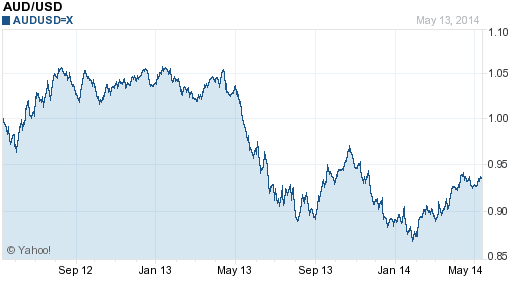
Two gauges of economic health augur tougher times ahead.  The central bank in Australia has pledged to keep interest rates at a record low of 2.5% for some time.  Along with this, the exchange rate for one Australian dollar has dropped below parity with the US dollar after having been worth more than its US counterpart in 2011 and 2012.  In contrast, New Zealand has seen its dollar continue to climb in value with the NZ central bank already having lifted interest rates twice to 3.0% in 2014.  It is milk and cheese that is driving the upturn in the New Zealand economy with the Chinese developing a taste for dairy products as their levels of wealth expand.

The shifting fortunes of Australia show that tapping into a growing Chinese economy has its downs as well as ups.  Despite this, New Zealand shows how change in China can be turned into a positive.  With China as one of the few bright spots in the global economy, this is a story that a lot of countries will be interested in.

Tuesday, 11 February 2014

No need to fear for the Fragile Five

While it may look like emerging markets are being tormented by global investors, there could be a happy ending.

What's in a name?  Well, the moniker “Fragile Five” suggests all is not rosy but the countries (Brazil, Turkey, India, Indonesia, and South Africa) labelled thus have things other than name calling to worry about.  Namely, the fact that it appears as though the Fragile Five are being picked on by the international financial system.  The leader of the pack has been the Federal Reserve whose trimming back of its stimulus package has triggered a massive shift in global finances.  While no country would choose to be browbeaten by investors, a lecture on bad economic policy might help these countries avoid a story of more woe in the future.

What is going wrong?

Emerging markets have fallen victim to the fleeting nature of foreign investors.  The global financial system has been awash with money due to central banks such as the Federal Reserve printing cash to stimulate Western economies.  Low financial returns in developed countries have prompted investors to look abroad for places to park their money.  Perkier economic growth in developing economies has been an oasis for investment as options elsewhere dried up.

Emerging markets are typically in need of extra cash.  There are little savings available to fund the investments needed to build homes, roads, and factories as the economy develops.  These cash-starved countries are a good fit with cash-rich investors but there is a need to get the balance right.  Unfortunately, many emerging economies come to overly depend on the cash provided by investors to fund their economic growth.  As is the case with things offered up on the cheap, the good times don’t always last and investors always have the option of taking their money elsewhere.

Along with slumping stock markets, the effects of emerging markets falling out of favour with investors are most keenly felt through a drop in currencies in emerging markets.  A weaker currency results in emerging markets having to pay more for their imports, which exacerbates the problem of high spending on overseas goods such as oil.  Higher prices for imports also push up inflation which is already too high in many emerging markets.  Many of these countries also struggle with large government budget deficits as slower economic growth prompts greater fiscal spending.

How things are being put right

While the Federal Reserve has been measured in its approach to changing policy, central banks in the Fragile Five have been all action.  The central bank in Turkey lifted its overnight lending rate for banks from 7.75% to 12% while their counterparts in other countries also increased their rates by smaller amounts.  The higher interest rates are designed to make it more attractive to hold the currency of that country as part of an attempt to stem the selling on the foreign exchange markets.  An increase in the costs of borrowing also has the effect of cooling the economy and reducing the demand for imports.

It is lucky for the Fragile Five that the most important actions have already been taken to prepare them for the ebb and flow of global capital.  Emerging economies have learnt from the Asian financial crisis in 1997 when many economies in Southeast Asia were decimated due to high levels of foreign debt and a system of fixed exchange rates.  The adoption of floating exchange rates along with large foreign currency reserves means that another crisis is unlikely.  Inflows of foreign funds are treated with less welcoming arms and greater acceptance of the need for controls over the movement of money in and out of economies with less developed financial systems (for more info, see beware of a flood of funds).

Your Neighbourhood Economist would even argue that there are some positives.  The global financial crisis and the Eurozone crisis have shown what can happen when imbalances in an economy get out of hand.  Investors can be a fickle bunch (many people are where money is concerned) but investor sentiment is typically a good gauge of how well an economy is operating.  If subprime mortgages or lending in southern Europe had also led to a revolt in the market, most of us would be better off (see bond investors ain’t all bad for more on this).  With this in mind, perhaps foreign investors should not be seen as bullies, but more like an older brother (who may not always be nice) keeping you out of trouble.

Monday, 25 November 2013

Good Deflation better than Bad Inflation

Central banks seem to be keen on avoiding deflation at any costs but inflation for its own sake is likely to be worse  

Inflation is on the retreat in much of the world giving rise to concerns about deflation.  Economic theory along with the experiences of Japan makes deflation one of the most feared outcomes in economics.  The central bank in Japan is planning to double its money supply as part of its battle to end deflation while the European Central Bank cut interest rates after inflation figures in October were too low for comfort.  The fears about deflation have resulted in policies which suggest that inflation in any form is better than deflation.  But deflation is a symptom of bigger problems and the prescribed cure may do more harm than good.

Economics textbooks paint a grim picture when it comes to deflation – lower prices translate to less money to pay off debts for both businesses and governments with consumers holding off on purchases if today’s prices are likely to be lower tomorrow.  Japan has been a case study of the damage done by deflation –the bursting of a gigantic financial bubble in 1989 resulted in around two decades of falling prices seen as sapping the life out of the Japanese economy while government debt has reached around 230% of GDP.  The years of deflation reinforced the notion of deflation feeding upon itself to reduce demand for goods and services and further drive down prices.

However, according to this rationale, deflation is the cause of the problem rather than simply a sign of a sluggish economy.  The reasons behind deflation are based on prices being too high as a result of unsustainable price increases in the past.  We can see an example of how this works in that stock prices in Japan are still less than half their peak value, highlighting the extent to which prices can be massively overinflated.  Prices for consumer goods are not subject to the same price pressures as in the stock market but the example illustrates the consequences of economic overheating.

There are parts of Europe with similar issues but nowhere is close to being on the same scale.  So, while Japan shows what can happen, its relevance to Europe is likely to be limited.  The deflation emerging in Europe, such as in Greece and Spain, is the result of weak demand coupled with falling wages which helps businesses by lower their costs.  The lower wages are needed for these countries to regain their competitiveness relative to the rest of Europe as other options, such as currency devaluation, are not available for countries in the Eurozone.

The response of central banks in Japan and Europe has been to use monetary policy to weaken their respective currencies but this targets the symptom and not the problem.  A weaker currency increases the price of imports and is tantamount to paying foreigners more to buy stuff just to create inflation for its own sake.  However, higher prices are more likely to result in consumers tightening their belts as their purchasing power diminishes.  The idea that low inflation requires more of the same approach misses the fact that these monetary policies bring their own costs with little benefit.  Deflation doesn't seem so bad in comparison.

Thursday, 21 November 2013

Monetary Policy – via the currency market

With the banking system clogged up, the European Central Bank is looking for other ways to make monetary policy work

Unconventional - this is a term currently used to describe many new elements of monetary policy such as quantitative easing.  It could also be employed in relation to the manner in which monetary policy works nowadays.  The European Central Bank (ECB) cut interest rates in November 2013 due to concerns about deflation (for more info, see previous blog) but the effects are not expected to work through the banking sector as would normally be the case.  Instead, the unspoken target of the policy change was the value of the euro.  This is stuff that you won’t find in any economics textbook, so how does it work and why is the ECB having to rely on such disingenuous tactics for its policies?

The normal result of a cut in interest rates would be a boost to the economy through an increase in lending with lower borrowing costs convincing more households and businesses to take out loans.  The extra spending that this generates would spur on the economy.  But this policy route is not working at the moment as demand for new loans is weak irrespective of how low interest rates are.  The fall in inflation has prompted growing concerns about deflation and the ECB felt the need for further action to signal its intent to prevent this.

Accordingly, the ECB is targeting another avenue (without stating it outright) to achieve the desired results – the currency market.  Europe has been burdened with a currency which reached a two-year high against the US dollar in October.  This is relevant to the fight against deflation in two ways – a stronger currency hurts the economy by making exports more expensive (and harder to sell overseas) as well as reducing the prices of imports (which adds to downward pressure on prices).  A reversal of this trend, that is, a weaker currency, would then work in Europe’s favour and is one of the few levers available to the ECB.

A lower interest rate helps to drag down the value of a currency by reducing the benefits of holding cash in that currency and providing an extra incentive to sell.  This effect is further magnified by the large amount of cash sloshing around in the global financial system at present.   But it is not so easy - some other central banks (namely the Bank of Japan) are keen on achieving the same results through similar policies and not all countries can have weak currencies.  This has resulted in the coining of the term "currency wars" as countries battle to drive down the value of their currencies.  It all sounds rather dramatic but it is evidence of how things in the system of finance are far from normal.

Wednesday, 20 November 2013

ECB Rate Cut – what's the point?

The European Central Bank set itself apart with looser monetary policy but how is this likely to make any difference to the economy?

Central banks have been busy recently, whether it be talk of forward guidance from the Bank of England or the tapering of bond purchases by the Federal Reserve.  The exception had been the European Central Bank (ECB) which had been going through a quiet period after monetary policy helped to put paid to the Eurozone crisis in 2012.  Worries about deflation jolted the ECB back into action following data showing that inflation was down to 0.7% in October.  The ECB decided to respond last week by cutting its benchmark interest rate from 0.5% to 0.25%.  But, with interest rates already low, will a further reduction make much of a difference to the economy?

A cut to interest rates is something of an anomaly as the ECB is the only major central bank which has not already lowered interest rates as much as possible.  The recent trimming of its key interest rate follows cuts in July 2012 and May 2013 with the ECB using this drip-feeding of interest rate changes to respond to new data on the economy in Europe.  The focus of policy has shifted from saving the Eurozone from collapse, which was achieved by the ECB taking a stand pledging to do “whatever it takes” to save the euro. Instead, the ECB is looking to boost growth with the hope of staving off deflation.

Lower prices may sound like a blessing to consumers but this fall has the effect of making debt tougher to pay back as selling the same amount of goods generates less money for firms which also means that the government misses out on tax revenues.  Not exactly what a heavily indebted Europe needs at the moment.  This is the reason why central banks will typically adjust policy to achieve inflation of around 2% - better to have a small amount of inflation than succumb to deflation.  Inflation has been decreasing elsewhere as well such as in the UK (see previous blog) due to weak growth combined with a fall in global commodity prices (see Inflation – then and now for more on how inflation works).


The interest rate cut in itself will actually have little effect with households and businesses in Europe not keen on borrowing while the economy is so weak.  Rather it is a signal of intent – the ECB will continue to loosen monetary policy while some central banks elsewhere (the US and, to a lesser extent, the UK) are approaching the beginning of the end of their loose monetary policy.  The key mechanism by which this will be fed through into the economy is likely to be the exchange rate but more on this later…

Monday, 1 July 2013

How Monetary Policy plays out in the Real World

The past week or so has shown hints of what is in store as the Federal Reserve hands back the reigns to the US economy.

The theory about the ramifications of the inevitable changes in monetary policy have been spelled out in this blog over the past couple of weeks (Caution - Windy Road Ahead) but market movements at the end of last week show how it will play out in practice.  Heavy selling last week was triggered by the rosy outlook painted by the chairman of the US Federal Reserve, Ben Bernanke, which was more upbeat than had been expected and is likely to signal that the end to bond buying by the Federal Reserve is nearer than many had thought.  It is worth taking a closer look at the reactions of the markets to get an idea of how future actions by central banks may impact on us all.

Bernanke’s statements around a week ago made the case that the economic recovery in the US was sufficient enough for the Federal Reserve to move forward with its plans to reduce its buying of bonds later in the year with a target of stopping completely in the middle of 2014. Pains were taken to get across the notion that the change in tact was not a tightening of monetary policy but just loosening at a slower pace and that any changes in monetary would depend on a continued recovery in the economy. Yet, because the bond buying by the Federal Reserve has become a crucial support holding up the prices of bonds and stocks, its imminent demise has rattled investors who were caught out by the bullish comments by Bernanke.  

The degree of surprise was spelled out in the sharp movements in the investment markets with prices of bonds plunging and the interest rate on 10 year US government debt jumping from around 1.5% to 2.5% (lower bond prices equate to higher interest rates). This will feed through into the real economy as government debt is typically the benchmark for which all other interest rates in the economy are set. The result will be higher interest payments for mortgage holders which will act as a damper on the promising recovery in the housing market in the US. The higher costs for borrowing will also be a point of concern for companies who are thinking of making new investments.

There are further negatives for the US economy from the changes in monetary policy – the ensuing volatility in the stock market will make households worry about their pensions and other investments making them less likely to spend. A slower pace of bond buying will result in a fall in the amount of new currency getting into circulation which will raise the value of the US currency.  A stronger dollar will make life more difficult for exporters, many of whom are already struggling in the global marketplace. 


This all puts the Federal Reserve in an awkward position of its own actions creating a headwind blowing in the opposite direction of where it is trying to get to – an end to its role of propping up the economy. Bernanke is trying to lessen negative effects of its bond buying plans by outlining in advance a clear schedule for its changes in policy. But the Federal Reserve also needs to ease concerns that it will act too fast and has allowed itself flexibility to modify its plans if the economic recovery weakens. The overall effect is the level of certainty which is craved by many investors will remain out of reach, and the twists and turns of monetary policy will be played out in jumpy markets that will keep everyone on their toes.

Tuesday, 4 June 2013

All bets are ON

Both the government in Japan and many investors are betting on the power of monetary policy but it is not much more than a roll of the dice.

Japan has long suffered at the hands of the same problems that have hit Europe, and as a result, the central bank in Japan has also been a pioneer of the loose monetary policy which has since become the mainstream response to such problems.  The recently-elected Japanese government has upped the stakes with a further round of monetary policy which goes far beyond anything previously proposed.  Investors too have been putting their money on the line in the hope that the new measures will bring about a long awaited revival in the Japanese economy.  However, the limited effect of monetary policy so far in the aftermath of the global financial crisis suggests that this is nothing more than a gamble in order to avoid some tougher choices.

A massive financial bubble in Japan in the late 1980s has resulted in two decades of economic stagnation due to the now common culprits of the overpriced real estate market, overwhelming government debt, and a lack of sources of growth.  The interest rates have been set close to zero for more than a decade while the Bank of Japan has also pumped money into the economy.  Successive Japanese governments have held back from making the necessary reforms to help the economy unwind the imbalances built up during the boom years and instead amassed debt equal to 230% of GDP, rather than deal with the problems that the country is facing. 

The new wager on monetary policy involves a doubling of the money supply as part of measures to achieve inflation of around 2% in two years.  However, the new monetary measures will just be another stalling tactic if not combined with other policies which help to kick start business activities.  The immediate effect of printing more money is that the value of the yen has dropped from below Y80 to over Y100 against the US$.  A weaker yen is a boon for many of Japan’s manufacturing giants who have large exporting operations.  The boost to their profits along with hopes for a new beginning for the Japanese economy has prompted many investors to throw in their lot with the Japanese government and the stock market surging by almost 70% in 6 months until a recent setback.

Yet this is symptomatic of actions by governments and investors across the globe.  Booms and busts in any economy involve considerable transformation as businesses adjust to new realities and government can either try to facilitate this process of companies adapting, which helps the economy become more productive over the long term, or stand up against forces of inevitable change to ease the short term pain.  Prior faith in monetary policy has enabled governments to believe that central banks have the power to restart economic growth with less hardship.  But new engines of growth are not given the scope to expand and monetary policy is relied upon more and more to prop up the economy. And using monetary policy to weaken a currency and boost exports will only work as long as the country’s central bank is expanding their money supply faster than anywhere else (for more on this, see Currency Wars).

This complicates the process of selecting investments with a layer of politics being overlapped with normal considerations of business profits and economic performance.  And with monetary policy taking a more dominant role in the strength of the economy, investors find it necessary to track the actions of central banks rather than just corporate activities and economic indicators.  As such, investors are second guessing what the central banks will do while the central banks take their best shot at what they think will be good for the economy. 


It is questionable whether the current set of policies that are commonly employed by central banks have been of much use so it is a considerable punt by the Japanese government to put all its money on more of the same despite any consensus which suggests otherwise.  But it is a way of being seen to be proactive while actually avoiding backing more difficult choices which are more likely to pay off in the long term.  And with bets in the stock market following the government line, this will multiply the losers and add to the woes of those who actually try to sort out the mess in the future.

Wednesday, 20 February 2013

Walking a Tight Line

Europe is being caught between convincing investors that all is well while trying to stop the improving outlook from feeding through to a strong currency.

All of the fires that had been keeping politicians busy over the past few years seem to have been put out – the Eurozone is no longer on the verge of collapsing, politicians have come up with a short-term comprise to deal with increasing government debt, and the outlook for the global economy looks likely to improve in 2013.  So with disasters averted, the focus is turning to generating growth in stagnating economies.  With domestic markets still sluggish, exports have been targeted as a route back to economic recovery and a weak currency is a crucial advantage.  But what seems easy in theory is tricky in practice.
This shift has been most pronounced in Europe.  The worst seems to be over with investors having been snapping up bonds from previously shunned countries such as Spain and Italy over the past few months.  But the long slog of getting the economies in Europe moving again still lies ahead (refer to Both Good News and Bad News for Europe for more on these two trends).  Exports have been targeted as a source of growth by tapping into perkier demand in emerging markets.  A weaker currency is an easy shortcut into foreign markets but such a policy is of little use (and could work to the determent of all) if other countries follow suit.  Hence, the rise of concerns about “currency wars” as the policy of central banks printing cash to prop up weak economies has also had the added benefit of lowering the value of currencies (for more on this, refer to Currency Wars).  Currencies will tend to fluctuate depending on economic forecasts with weak growth linked to a low interest rate which puts off investors from holding cash in that currency. 
The new government in Japan has been quick to push its central bank into pumping out more cash.  On the other hand, Europe has been hamstrung by fears about inflation from the overly cautious Germans as well as brighter prospects for its economy now that the dark clouds of the Eurozone crisis seem to have passed.  So the improving situations in Europe along with its less aggressive monetary policy could saddle the Eurozone with a strong euro which could scupper the recovery.  The euro had held up reasonably well despite the turmoil as the currency remained necessary for trading with the large single market in Europe.  The perceived turnaround with regard to the fate of the euro has resulted in investors rushing in to buy bonds of Spain, Italy, and the like due to their higher interest rates. 
A further problem is the different competing view on what would be a suitable policy with regard to the euro.  On one side of the argument, the French president Francois Hollande has called for a managed exchange rate with a target for the exchange rate set by the European Central Bank.  France is averse to market reforms which would improve competitiveness so a weaker euro is an easier option.  Jens Weidmann who is the head of the Central Bank in Germany sits at the other end of the spectrum and argues against a weak euro as this will increase inflation (due to imports becoming more expensive).  The Germans have also been among those most vocally critical of the Japanese government influence over its central bank and its aims to reduce the value of the yen. 

Squeezed between the two powers (France and Germany) in Europe is Mario Draghi, the president of the head of the European Central Bank, who takes a more nuanced stance.  It is Draghi who has done the most to stabilize the situation in the Eurozone (see Whatever it takes) and has tried to instil confidence in the fate of Europe while stopping the euro getting stronger as a result.   Draghi came out with a statement earlier this month that it was not the role of the European Central Bank to dictate the value of the euro.  However, strengthening of the euro and any resulting inflation would require action.  This would involve interest rates being nudged up from their current low levels and the growth prospects in Europe would suffer as a result – hence stopping a possible rise in the euro in its tracks.
If Your Neighbourhood Economist was to bet money on the outcome of this tussle, it would bet on Draghi.  The ability of the European Central Bank to act without being restricted by what voters might think gives a reason for investors to listen to what Draghi has to say.  The policy of the European Central Bank to do “whatever it takes” has helped to save the Eurozone despite no action having been taken as yet and this shows how an intention to act by itself can influence the market forces.  It may take more than words and a splash of extra cash to keep Europe on track but the situation could be significantly worse considering the competing opinions in Europe.

Tuesday, 19 February 2013

Disappearance of the “Strong Dollar”

The demise of this phrase from the lexicon of politicians in the United States says a lot about the changing landscape of the global economy.

It is easy to notice when a new term pops up but harder to spot when a phrase falls out of use.  Adherence to the principle of a “strong dollar” was a cornerstone of government policy in the United States for generations but it is not something that is referred to by politicians anymore.  Your Neighbourhood Economist would argue that this change in thinking by politicians about the US dollar that has mostly gone unnoticed is part of a wider picture of the changing global position of the United States.
It may seem strange at a time when countries are vying with each other to weaken their currencies (for more, see Currency Wars), but not so long ago, politicians in the United States would pledge their support for the notion of a strong dollar.  But the origin of the strong dollar was from a previous era when the United States was the dominant global trading power.  Trade flows in the thirty years following the Second World War typically followed a certain pattern – rich, developed countries such as the United States would import agricultural products and raw materials for manufacturing while importing manufactured goods back to the poorer, less developed countries. 

Manufacturing at this time was limited to a small group of privileged countries that benefitted from economies of scale stemming from their large and wealthy domestic markets.  Most other countries were limited to importing materials which ended up being plentiful and cheap due to the large number of other countries having nothing else to offer in terms of trading.  So the United States was in an advantageous position of being one of a few that supplied crucial manufacturing products but having a wide choice of trading partners in other goods.  Its dominance was extenuated with many other manufacturing countries being decimated following the War. 
This central role of the United States in the global economy also extended to its currency and the US dollar was used in trading between different countries and as a means for any country to store its wealth.  The widespread popularity of the US dollar increased its value which put the United States in an even better position.  A strong currency helped businesses in the United States by making imports cheaper but was only helpful in so far that there was minimal competition regarding exports.  

While the United States remained on top for a few decades after World War II, it inevitably faced numerous challenges.  The oil embargos in the 1970s were a shock to the system but it was the rise of Japan as a manufacturing rival that signalled that the good times were coming to an end.  Companies in the United States had grown flabby and slow due to a lack of competition.  Focused and ambitious Japanese firms easily outperformed their US rivals in areas such as cars and consumer electronics.  The revival of business in the United States was facilitated in part due to an agreement in 1985 to revalue the Japanese yen at a higher value. 
However, the new competition from Japan was just a sign of things to come as other countries in Asia such as South Korea and Taiwan followed in the footsteps of Japan culminating in the re-emergence of the sleeping dragon, China.  The global economy was in the process of becoming increasingly interlinked due to lower costs for transport and communication and the resulting surge in imports into the United States devastated some local manufacturing industries.  Surviving businesses in the United States lobbied for support from the government through protectionist measures.  Yet, politicians maintained their belief in the benefits of a strong dollar with reiterations of this policy being repeated as recently as during the Bush Junior administration.

The United States government policy regarding its currency eventually caught up with the realities of the repositioning of the United States in the global pecking order.  Nowadays, the only mention relating to the US dollar by politicians is belligerent moaning about the perceived injustices stemming from a belief that China is manipulating its currency.  This is part of an increasing vocal backlash looking to stem the flood of goods from overseas and reflects the difficulties that businesses in the United States are having as globalization increases the number of rivals.  Slower economic growth and an increasingly high debt burden means that exporting is becoming more important as the United States economy has to work harder to generate growth.  This is one of the many challenges that are likely to lie ahead as the United States scrambles to hold onto its global crown.

Monday, 28 January 2013

Currency Wars – Japan’s Central Bank Strikes Back

Japan ups the ante with policy makers eyeing monetary policy as a means to weaken their currency but where will it end…

Currency wars is not exactly the stuff of the latest blockbuster showing at the cinema but the issue is making headlines and setting pulses racing.  And it is the normal staid world of monetary policy that is the cause of the tensions.  In the face of weak economic growth, most central banks in developed countries tend to set interest rates close to zero and have had to resort to the unconventional tactic of quantitative easing or the buying of bonds to increase the money supply.  Creating more money in this way has an added effect of also reducing the value of the currency (see Where is all the money going? for more on quantitative easing) and a lower currency is helpful for exporters trying to sell their goods overseas.  With more quantitative easing acting to prompt more exporting, it is an easy way to help out businesses who may be suffering from sluggish demand in their domestic market.  So with quantitative easing all the rage, are central banks set to battle it out to see who can print the most money?

Central banks are not typically caught up in efforts to stimulate the economy.  Their role typically involves maintaining inflation near a target level.  However, the persistent stagnation in the global economy combined with high levels of debt in many countries has taken away governments’ abilities to revive the economy through increased spending or lower taxes.  As such, central banks have been enlisted to combat the worst economic slump since the Great Depression.  Quantitative easing was initially called into service as a boost to the economy but its effects on the currency markets have not gone unnoticed.

The latest salvo which has ramped up tensions was the Bank of Japan (the central bank in Japan) raising its inflation target from 1% to 2% following political pressure from the newly elected government in Japan.  It is not the action of the Japanese central bank that is causing concerns but that the Bank of Japan acted under a barrage of pressure from the government.  It is seen as crucial that central banks are allowed to operate for the good of the economy free from outside influences.  This independence from political pressure is the crux of the argument for central banks being entrusted with monetary policy (see More Power to Economists for more on why this is the case).

The flip side of the coin is that Japan has fallen victim to peculiarities of the currency markets following the onset of the global financial crisis in 2008.  Normally, the value of a currency would fall when the economy is doing poorly but the opposite has happened to the yen which surged in strength from above Y120 per US$ in 2007 to below Y80 per US$ in 2012.  So, as well as a recession in their home market and a drop in global demand for exports, Japanese business were under fire due to a strong currency resulting in the prices of goods exported from Japan becoming more expensive in foreign markets (for more detail, refer to Yen as Weathervane).  As a result, Japan posted its largest ever trade deficit in 2012 which is a sharp turnaround for a country known for its exporting prowess.

The new stance by the central bank in Japan had the desired effect with the yen dropping back above Y90 per $US but the plunge in the yen is based on market expectations of what could happen as the Bank of Japan has yet to do anything.  Furthermore, it is even unclear on what Japan’s central bank will do to work toward a “medium to long-term” goal of 2% inflation.  The Bank of Japan has not had any luck in lifting the country out of deflation and reaching its prior target of 1% inflation so it remains to be seen whether the shift in stance will have any effect.  An immediate change is the further politicization of central banks who have gradually been given more responsibility for the economy than was part of their initial remit.  The use of monetary policy as means of manipulating the currency is now in the sights of policymakers across the globe.  This poses the question - do other countries dare follow Japan’s lead?  There might be a sequel: ‘Currency Wars - Return of the Printing Presses’?

Monday, 8 October 2012

Where is all the money going?

Central banks in the world’s largest economies, the European Central Bank and the Federal Reserve in the United States, have recently announced plans for creating an unlimited amount of money.  A third central bank, the Bank of Japan, also has announced its intent to pump even more cash into the Japanese economy.  The funds from the central banks are used to buy bonds with the goal of pushing down interest rates (for details – see The Demand and Supply of Money).  The money received by those selling the bonds has to go somewhere.  But it is not always clear where the money will go.  Image pumping more and more jam into a donut – some of the jam will go where it is supposed to but the jam will at some point spurt out in unintended directions and make a bit of a mess.

The buying of bonds by the central banks will increase the prices of bonds and decrease the interest rates which mean that bonds will be a less attractive investment.  The shift of funds away from the bonds being brought by the central banks to other sectors of the economy is seen as an added benefit along with the lower interest rates.  It will help to reduce the borrowing costs of companies which would make them more likely to invest.  But the anaemic state of the economy suggests that such investment is still muted. 

Money has also moved from the bond market into shares.  This also has an upside due to what is known as the wealth effect – consumers will spend more when they perceive themselves to be wealthier (when their shares are worth more).  But any gains in the stock market due to this can only be temporary as the underlying value of the shares which depends on the profitability of the companies can only improve along with the economy.  This had not stopped the stock markets reacting vigorously to the perceived intentions of the central banks.

Considering the global nature of finance, the money does not only stay within the same country but spans the globe looking for the highest return.  However, the bond buying policies add to the colossal amount of funds that can potentially cause havoc in the economies which are their final destinations.  A flood of money surging into a country will increase the value of its currency while putting downward pressure on the currency in the country where the bond buying is taking place.  This dents the exports of the former while boosting the exports of the latter and the bond buying has been labelled as a protectionist policy at a time when sluggish economies make most countries desperate to boost exports.

A previous victim has been Brazil where the value of its currency, the real, climbed to above R$1.6 against the US dollar in July 2011 after having dropped briefly to below R$2.4 against the US dollar at the end of 2008.  The volume of its exports has suffered as a result and the Brazilian economy has slowed.  A strong currency is also a problem in Japan where the central bank followed the lead of central banks in Europe and the United States with its own bond buying plans with one eye on its currency.  The Japanese yen is still close to its record high of around Y76 against the US dollar which was reached in October 2011. 

In the old economic textbooks, the value of currencies would be dictated by the relative competitiveness of different economies.  More competitive economies would be able to export more and the funds drawn in from overseas as a result would increase the value of the currency.  The opposite would hold true for less competitive economies and the system of global trade would trend toward equilibrium as a higher currency would make more competitive economies less so and vice versa.  However, the flow of money across borders now overwhelms the flow of goods and it is the cash that is sloshing around in the global financial system which dictates movements in the currency markets. 

These funds are often completely separated from the reality of the underlying economy and the same forces that push the overall system to equilibrium are not at work as would be the case when trade in goods dominates.  This combined with the ability for cash to be moved almost instantaneously has profound and often chaotic effects on the global economy and our understanding of the economy still lags behind these new circumstances – a humbling reality for any economist.

Saturday, 26 May 2012

“Should I ask to be paid in pounds?”


A friend who had recently moved from the UK to a new job in Europe recently asked the question which is the title of this posting.  While the question may have been half in jest, it did reflect concerns about what will happen to the euro if Greece was to leave.  The reply was that there was not much to be worried about and here’s why.

For starters, Greece is very small in comparison with the rest of the Eurozone.  The GDP of Greece is only just over 2% of the GDP of the Eurozone.  A larger currency union means that people would have more reason to hold money in that currency and this would increase demand and the value of the currency.  But because Greece is so tiny and not central to business in Europe, the effects on the value of the euro from its exit would be minimal. 

Forgetting about other factors, the departure of Greece may even be a boost to the euro as it would end a saga that has brought a cloud over the euro.  However, it is the possible follow-on effects more than the actions of Greece itself that are the real concern.  If one country leaves the euro, it sets a precedent and makes it easier for others to follow.  Investors then begin to worry about this and move their money out of any struggling country which in turn makes it tougher for these countries and increases the likelihood that they also may have to leave the euro.  People in those countries would start withdrawing money from banks due to fears about losing out with the change to a new and weaker currency. 

The fears about other countries leaving the euro then become a self-fulfilling prophecy and one country after the next may become the target of this.  In this manner, first, the smaller countries of Portugal and Ireland, then probably Spain, followed by Italy, and even maybe France could fall like dominos.  If such a chain of events begins, it is difficult to know where it might end. 

What would be required to stop this would be the leaders in Europe drawing a metaphorical line in the sand to state that Europe stands behind a certain group of countries.  The leaders in Europe need to show conviction in standing behind the struggling countries and earn the trust of investors who will not bring their money back until they think it is safe.  As obvious as this sounds, it is not something that Europe has managed so far and still may be beyond their leaders.

Despite all the turmoil, the euro as a currency has held up surprising well.  Demand for the euro has stayed strong due to the size of the Eurozone which makes the euro a useful currency to have.  Even though there has been lots of selling of bonds issued by Greece and others, German bonds have been popular.  Big investors and others with lots of cash such as reserve banks in Asia like to spread their investments over many different regions and will always hold a large portion in euros.  Investors who want to make money from the troubles in Europe have done so by selling bonds of particular countries rather than selling euros.

So the euro has stayed around 1.30 vs the US dollar so far this year which is similar to where the euro was trading at the beginning of 2011.  A weak patch this week prompted the euro to drop to near 1.25 vs the US dollar and hit a two year low (or a three year low of 0.80 vs the UK pound).  It remains to be seen whether this is just a blip or whether investors have become fed-up with politicians and are moving money elsewhere.  Either way, my friend may lose a bit of money if he wants to convert it back to pounds but that all depends on the timing of the change as the euro is likely to recover at some stage.  However, it is not something to lose sleep over (yet).

Sunday, 1 April 2012

Yen as weathervane for global economy

Recent previous postings in this blog had looked at where investors move their money in the good times and the bad.  The choice is not limited to just stocks and bonds but also to what currency to invest in.  One currency more than all others has seen its fortunes dominated by the global flow of money, the Japanese yen, and has sometimes had to pay the price.

In economic text books back when Your Neighbourhood Economist was at university, currencies were determined based on trade flows.  If a country exported more goods and services than it imported (a positive balance of trade), its currency would rise.  The higher currency would mean that the price of exports increased and imports decreased so that the balance of trade would head back toward zero. 

However, globalization has meant that the flow of goods between countries has been overwhelmed by a flood of cash and so it is this that dictates the value of a currency.  Investors now move their money into countries that were growing and as a result had high interest rates.  Cash inflows into a country would lift the currency and raise the value of any investments in that country giving investors a boost to their returns. 

With money becoming increasingly easy to come by, investors came up with a new trick – borrow money in a country with a low interest rate and move it somewhere with a higher interest rate.  This is what is known as the carry trade and is where the yen comes in.

The Japanese economy has been in the doldrums after the bursting of a massive investment bubble in the late 1980s.  Its interest rates have been close to zero for a long time so investors could borrow in yen and invest in bonds in other countries with relatively low risk.  The carry trade also resulted in the yen being weaker than it normally would have been, because investors would sell the yen that they had borrowed, despite a large balance of trade and other factors that should have been driving the yen higher. 

The yen thus became a gauge of the world economy.  As long as interest rates elsewhere remained high on the back of a buoyant global economy, the yen would stay weak.  On the other hand, an economic downturn would lower interest rates globally and prompt investors to buy yen to repay their borrowing which caused the yen to rise.  So there was a link established whereby the yen was the currency to hold if an investor was pessimistic about the global economy.  That interest rates in Japan were close to zero didn’t matter as interest rates would be low everywhere during a global downturn.  Thus, the yen became a safe haven where investors would park their money when the economy turned bad.

The result of this is that, despite the onset of a recession both globally and in Japan, the yen was rising.  This was a major blow to Japanese manufacturers which export lots of TVs and cars and are the mainstay of the Japanese economy.  Perhaps, most perversely of all, the tsunami that devastated the Japanese northeast prompted a further rise in the yen.  This was because the havoc caused by the tsunami was seen as being bad for the global economy due to its effect on Japanese business in the region which supplied parts to many international firms.

The yen reached peak of above 120 yen to the US dollar in mid 2007 to almost 75 yen to the US dollar early in 2012.  So a jump in the yen to near 85 yen to the US dollar in March sparked interest that the direction of the market was about to change.  The upturn in the yen was triggered by an announcement of further easing by the central bank in Japan which comes at a time where other central banks are winding down their efforts to prop up their economies.  But little respite is expected for the Japanese economy until the interest rates else where such as in the US rise further.  For now, Japan looks stuck with a currency which is more of a weathervane for the global economy than a currency that reflects its domestic economic climate.