Showing posts with label Emerging Markets. Show all posts

Wednesday, 22 July 2015

China - staying out of the news

A tumble in stock prices gives rise to more worries about China but it is not deserving of the bad press

News about China often hits the front pages as its swift rise is both scary and a source of economic salvation.  Stock markets in China have been making news recent due to a sharp selloff in shares.  The media are quick to jump on any potential hiccup in China’s rapid expansion due to its growing importance as a global economic superpower.  Yet, the peculiarities of stock markets in China mean that the spill over effects are likely to be limited even though the financial sector will continue to be a source for headlines in the future.

New to this game

Picking the right stocks and when to buy them is never easy but it is even trickier with China being a relative newcomer to trading shares.  The shorter the period of time over which shares have been traded, the more difficult it is to pin down what should be paid for stocks.  Many of the companies themselves are also still young and are still fighting a fierce battle with rivals for survival.  On top of this, the bulk of the investors in the Chinese markets are locals and have less experience in trading stock. 

The government further muddies the picture with its plans for liberalising the financial markets.  While fewer restrictions would be welcomed, the reforms create jitters due to the potential pace of change depending on the whims of its leaders.  Yet, the government regulations in themselves are part of the problem.  One issue is limits on how much banks can pay out in interest on savings accounts.  Starved of other places to put any spare cash, too many Chinese look to make money in domestic share markets which are ill equip to deal with the inflows.

While many eager investors have managed to sidestep the barriers, heavy regulation of the financial markets keeps out many more Chinese.  This has the effect of limiting any losses when the inevitable selloffs hit the stock markets.  In this way, the government ensures that the underlying economy is sheltered from any volatility in the stock markets.  Neither is the stock market much of a reflection of what is going on in the actual economy.  Chinese stock prices had stagnated for a long time prior to the recent ups and downs so it is unlikely that any bad news in the stock markets will be a prelude to trouble with the economy.

Watch this space

All this would not make the headlines if happening in any other emerging market but China is a big deal these days.  Its importance as the main global driver for economic growth makes outsiders nervous.  Its haphazard mix of free market and government control means that pessimists are quick to spot its faults.  But, just like with the patchy rules governing financial markets, the government has adapted in the past to stay on top of problems before things get out of hand.


The fear of market turmoil spilling over to society at large will continue to keep the Chinese on a cautious path to freeing up financial markets.  Over this time, China will continue to be plagued by a jumpy stock market as its investors grow used to the ups and downs of share prices.  Considering that even Western investors have not fully mastered this, the trials and tribulations of Chinese share prices will likely to be hitting headlines again many times in the future.  But, with government policy helping to stem the spread of any losses, it is not something that needs to cause too much worry yet.

Thursday, 14 May 2015

Emerging Markets – Caught in the Crossfire

US monetary policy has missed its mark and it is a handful of emerging markets that look set to pay the price

The big guns of monetary policy used to combat sluggish economic growth are about to be put away but the real damage may be just about to kick in.  The Federal Reserve adopted loose monetary policy to get the US economy moving again but it is elsewhere where the effects have been felt the most.  Having benefited more from the loose monetary policy than the intended target, some emerging markets look set to suffer as a policy reversal prompts US investors to stage a destructive retreat back home.

Danger zone

The proverbial printing presses at central banks are like the heavy artillery of monetary policy.  Central banks such as the Federal Reserve had been pumping out cash to buy bonds as part of quantitative easing.  Yet, the US economy had failed to fire up with companies unwilling to invest while spending remains weak.  Investors with cash in hand turned their sights overseas and targeted emerging markets where economic growth was still perky. 

The surplus US dollars helped to lower interest rates for borrowers in many countries which had not gotten caught up in the global financial crisis.  The reduced borrowing costs pushed up lending elsewhere despite not having the same effects in the US economy.  The muted effects of monetary policy in the domestic economy prompted the Federal Reserve to unleash even more firepower.  Money, like some things, is fine in moderation but the bombardment of US dollars inadvertently created its own minefield. 

Borrowers in emerging market were only given access to cheap cash by borrowing in US dollars for a short period of time.  This was fine as long as the prospects for the US economy were poor and US dollars were readily available.  But any significant improvement in the US economy would see investors shift their money back.  A stronger US economy would also push up the value of the US dollar and make it tougher for overseas borrowers to pay off any debts in US dollars. 

Collateral damage

Like solider stationed in a hostile region, investors were set up to bail when the opportunity arose.  Just the mere mention by the Federal Reserve in May 2013 that quantitative easing might be coming to an end was enough to trigger a rush by investors to get their money out.  Six months of market volatility followed even though quantitative easing did not actually end until October 2014.  With the Federal Reserve now mulling lifting interest rates up from their low levels, more upheaval seems likely.

This is because money often does more damage on the way out compared to the gains when it is initially welcomed.  Yet, the lure of cheap cash is too much to ignore.  Even the financial sectors in richer countries have shown themselves to be unable to cope when too much money is on offer.  Less developed banking systems in emerging markets are often even worse at putting any cash to good use.  This increases the likelihood that many borrowers will struggle when US dollars are harder to come by. 

As the aftermath of the global financial crisis has made painfully clear, a swift end to a lending boom is not something easy to get over.  In its attempts to deal with an US economy sagging under the weight of excess debt, the Federal Reserve has inflicted the same woes on others who are less able to deal with the consequences.  Like any form of warfare, it is the innocent victims that suffer the most.

Tuesday, 28 April 2015

China – Playing Catch Up

Many expect the Chinese economy to misbehave but it is more likely that China will grow out itself out of trouble

China is growing up in front of our eyes and there is an expectation that, like any adolescent, it will get into trouble before fulfilling its promise.  Naysayers predict that China’s growth spurt has left it with a number of issues that must be worked through before it can get any bigger.  Yet, China has a good head on its shoulders in the form of the Communist Party which will do all it can to keep the economy buoyant.  While the years of stellar growth are likely over, it need not mean that the Chinese economy will be held back.

Big trouble in (not so) little China?

The spectacular rate of growth achieved by China over the past decade could never continue forever.  Quite the opposite, the rapid expansion would have been harmful if it had been maintained and a slower pace of growth is actually a preferable outcome.  This is because much of the economic growth had been fuelled by investment – construction of new factories to sell cheap goods overseas along with the expansion of megacities in China to accommodate an influx of workers from the countryside. Normally, investment accounts for around 10% to 15% of GDP in most developed countries but reached 50% of GDP in China. 

This building frenzy could not continue especially when it is becoming more difficult to make money and some investments would be wasted on pointless projects.  It is the examples of this, empty apartment blocks and overly lavish public spending, that pessimists point to as evidence that China has gone too far.  With large amounts of bad debt expected to result from these poor investments, the financial sector is expected to take a big hit and drag the whole economy down with it.  The argument is basically that China has gotten too big for its boots and will need to shrink.

Growing up is never easy

Your Neighbourhood Economist would instead argue that China has a similar problem to what he had when he was growing up.  His mother would buy Your Neighbourhood Economist clothes that were too big for him in the knowledge that he would grow into them.  It is ungainly to be sporting oversized gear and this seems to be similar to the phase China is going through.  This is partly because China had been expanding so quickly that any investment needs to be put up in a hurry.  There is also the added complication of spending getting out of hand as regional politicians try to impress their bosses in the Communist Party.

Yet, China, like a much younger version of Your Neighbourhood Economist, still has a lot of growing to do.  Some of the ill-fitting parts of the Chinese economy may be put to better use as its citizen will continue to migrate toward the cities in search of work.  China has also learnt lessons from its investment binge with the central government shifting emphasis from economic growth to other benefits of greater wealth such as a cleaner environment and a more efficient bureaucracy.  Local officials are being brought into line through a crackdown on corruption and concentration of power within the Communist Party.

Along with changes to policy, the Chinese government also has the resources to deal with any past mistakes.  With both domestic savings and government reserves at high levels, there is plenty of money around if needed.  And, with an eye firmly fixed on keeping the economy growing, the Communist Party would not be as timid compared to Western governments in terms of stepping in and shoring up the banking sector if needed.  China is also moving away from investment as the driver of its economic growth and consumption is expected to pick up the slack (albeit with growth at a slower pace).

Growing while you watch

Your Neighbourhood Economist has seen the change in China with his own eyes.  In a visit 15 years ago, the Pudong area across the river in Shanghai seemed like a ghost town but one that had been freshly built with a scattering of skyscrapers.  Now, Pudong is anything but quiet and the pace at which new buildings continue to go up is testament to China’s growth.  It also shows that it you build it (in China at least), they will (still) come.

Wednesday, 14 May 2014

Growth in China: Steel vs Butter

Diverging fortunes of countries down under illustrate how China is changing

Trading with China can be like a roller coaster ride – lots of ups and downs without knowing what is coming next.  At a time when most of the global economy has been in the doldrums, tapping into the Chinese market has lifted the economies of a lucky few.  Australia and New Zealand are among the fortunate ones, but the diverging fortunes of these two countries highlight a shift in China’s development which will have profound effects for many others.

Riding out the twists and turns

Economic development of any country is never a smooth ride.  Growth in China has been bumpier than most with its economy jumping into life at a time when the world was becoming a much smaller place due to globalization.  The Chinese economy has expanded at an unprecedented pace due to its role as a manufacturing base built on access to foreign markets and funds from overseas. This has resulted in greater scarcity of many of the basic commodities extracted from or grown in the ground.

Countries fortunate enough to possess an abundance of natural resources, such as many in South America and Africa, gained a boost from high commodity prices at a time when the global economy is weak.  But these benefits are likely to be a temporary upturn with demand for commodities shifting as China develops.  The initial stages of the growth in China came through investment amid a building frenzy as firms rushed to put up factories to produce goods for exporting.  This has continued as the Chinese government has ramped up spending on infrastructure to counteract the weak global economy. 

The result has been a prolonged period of China sucking in resources such as iron ore, coal, and natural gas.  However, spending on investment was surging ahead at a pace which could not continue and has shown signs of an inevitable tailing off over the past year or so.  The government has instead eyed consumption as a new source of economic growth and as a means to keep the population happy.  This change in focus in China will be felt throughout the global economy.

Good and bad of changes in China

China was at the forefront of the mind of Your Neighbourhood Economist during a recent visit back home to New Zealand and a side trip to Australia.  Demand from China helped both countries to avoid a downward spiral following the global financial crisis, with Australia racking up an astounding 22 years without a recession.  Yet, it is Australia that is looking nervously at developments in China while New Zealand is looking to raise interest rates due to a booming export industry. 

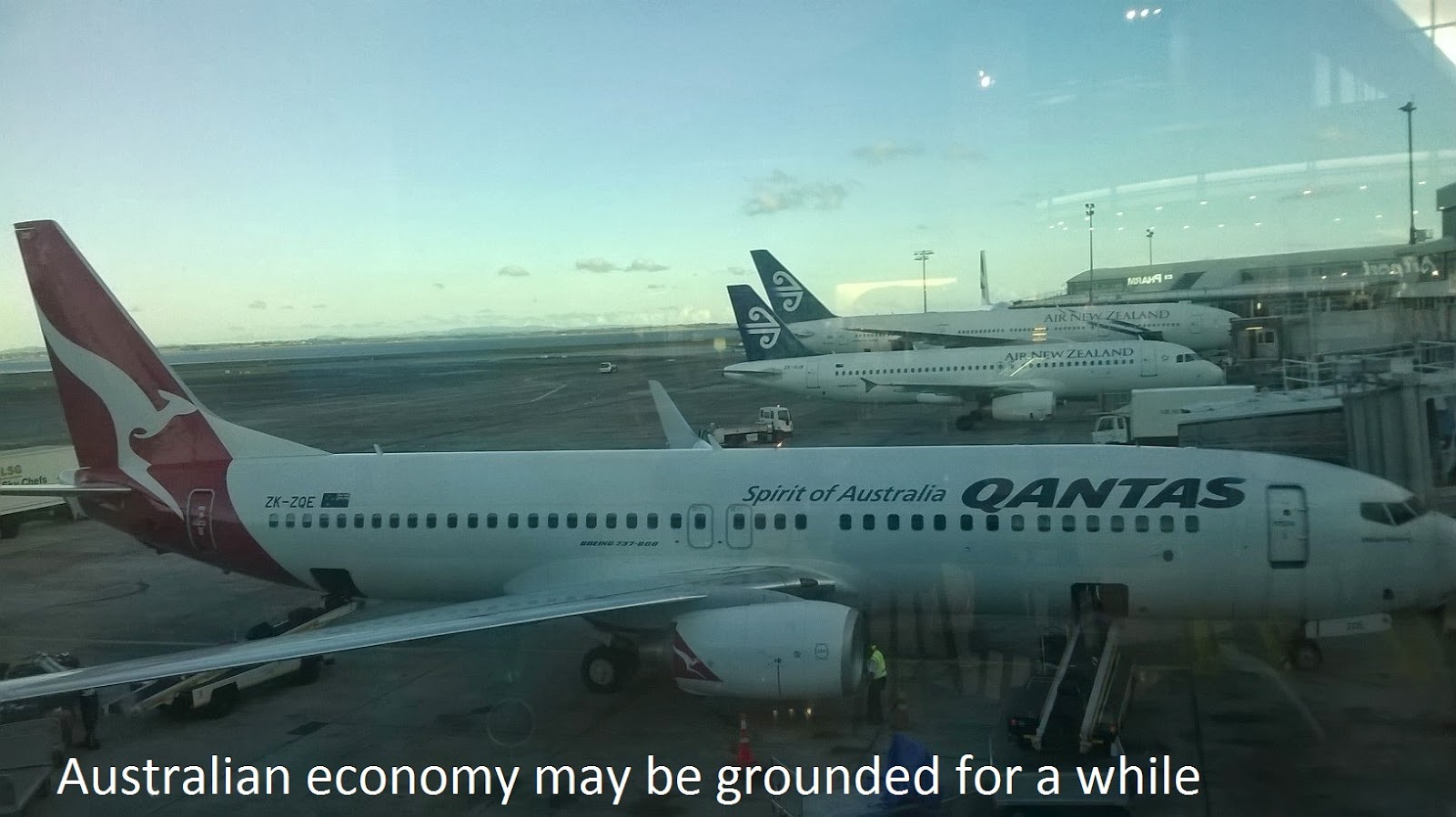
The reason for concern among Australians is that its mining boom is starting to peter out.  Exports to China are still hitting record highs even as growth in the Chinese economy slows.  But investment in the mining industry has dropped off as commodity prices have fallen.  This leaves Australia in a tricky position as money from mining has pushed up the cost of living, resulting in wages that are too high to be competitive.  Employment may be starting to suffer - Your Neighbourhood Economist struggled to spot many Australians among the cabin crew on the Qantas flights to and from London.

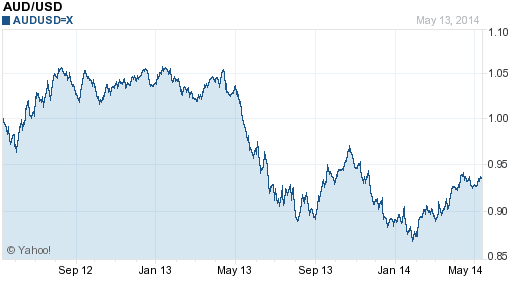
Two gauges of economic health augur tougher times ahead.  The central bank in Australia has pledged to keep interest rates at a record low of 2.5% for some time.  Along with this, the exchange rate for one Australian dollar has dropped below parity with the US dollar after having been worth more than its US counterpart in 2011 and 2012.  In contrast, New Zealand has seen its dollar continue to climb in value with the NZ central bank already having lifted interest rates twice to 3.0% in 2014.  It is milk and cheese that is driving the upturn in the New Zealand economy with the Chinese developing a taste for dairy products as their levels of wealth expand.

The shifting fortunes of Australia show that tapping into a growing Chinese economy has its downs as well as ups.  Despite this, New Zealand shows how change in China can be turned into a positive.  With China as one of the few bright spots in the global economy, this is a story that a lot of countries will be interested in.

Monday, 12 May 2014

US Monetary Policy – Investors face stormy future

US investors have been blessed with calm seas of late but their good luck is unlikely to last

Monetary Policy has entered a period of calm after enduring something of a turbulent passage through the global financial crisis.  The unprecedented tempest which buffeted the banking sector led central banks to trial a number of measures never seen before.  Yet, since tapering of quantitative easing was launched at the end of 2013, it has been relatively smooth sailing.  Tapering has been implemented in steady waves so as to not shake the delicate stomachs of investors.  However, rather than signalling the end of the choppy weather in the financial markets, the current lull could just be the eye of the storm.

Skies clear following predictable monetary policy

Investors prefer favourable conditions in the same way as sailors.  A view far ahead to the horizon is prized in the financial markets as well as by mariners.  One element that helps investors to better plan a course for the future is having a predictable monetary policy as a guide.  Investors had come to rely too much on the Federal Reserve as a steady hand at the helm using quantitative easing to put some wind back in the sails of the US economy.  Problems thus arose when the Federal Reserve first floated the idea of trimming back its expansive monetary policy in the middle of 2013.

What was a stiff breeze for the US hit many emerging markets like a financial hurricane.  This is because a considerable portion of the money printed in the US had travelled the globe in search of more bountiful returns.  Some developing countries had become a haven for the extra cash but the money left in a whirlwind once the prospects for returns in the US picked up.  The resulting market turbulence pushed some countries to the brink of going under, but investors eventually settled down again after adjusting to the new forecasts.

The outlook for US monetary policy has brightened considerably with the steady progression of tapering.  The Federal Reserve has cut back its purchasing of bonds by US$10 billion at each of its meetings, which happen almost every month.  As a result, bond purchases have been reduced a few times already in 2014 and fell from US$85 billion in late 2013 to US$45 billion at the most recent meeting at the end of April.  The predictability of US monetary policy also survived the potential shipwreck that was the change in skipper from Ben Bernanke to Janet Yellen at the beginning of the year.

Forecast for storms ahead

All is well for now.  However, there may be trouble on the horizon as tapering is just the start of the Federal Reserve relinquishing its role of propping up the economy.  A bigger storm may be coming next year as interest rates have to be raised from their current record low levels.  The Federal Reserve has pledged not to change interest rates for a while as it monitors the economic recovery.  Interest rate hikes must happen sometime in the next year or so especially in light of the surprising improvements in the US job market.

The end of quantitative easing and higher interest rates are all part of a voyage back to normality.  It has been a strange new world in terms of both the financial markets and monetary policy following the waves of financial havoc over the past several years.  The recent squalls that hit emerging markets can be seen as a necessary part of this journey.  Nevertheless, other rough patches may still lie ahead considering that it is far from normal for US stocks to be pushing on record highs despite slow economic growth

While it is tough to gauge what normal should look like in terms of the financial markets, the signs indicate that rough seas lie ahead.  Emerging markets have already taken a beating which makes it likely that the next storm may strike US investors closer to home.  

Tuesday, 8 April 2014

China and its growing pains

The Chinese economy is treated like a problem child by the media but does not deserve its bad reputation

Growing pains have led to a lot of bad press recently for both China and Justin Bieber.  The development of both has been closely watched for any signs they are going off the rails.  Bieber has been much maligned for bad behaviour as he shakes off a boyish image.  China has been the driver of growth in the global economy but may not continue to fulfil this role.  Just like Bieber, much of the new stories on China are negative but China is different in that it does not deserve the harsh treatment in the press.

Big trouble in little China?

Like a spoilt kid growing up in front of the media, a developing economy can always expect a few troubles along the way.  Even more so when every step is analysed in detail as has been the case with the once-in-a-generation rise of a new superpower (China, not Justin Bieber).  The Chinese economy always seems to be on the cusp of a breakdown according to many experts.

The current concern with China is the high level of debt amid a surge in investment.  Some of the money has gone into projects that have not panned out as shown by empty housing apartments and dodgy infrastructure ventures.  The bulk of wayward spending tends to turn up in out-of-the-way places, such as the far-flung regions of China.  Here, both private and public investment is driven more by politics than by financial fundamentals.

Local politicians need a growing economy to please their masters in central government.  Large building projects are a convenient shortcut to achieve this and banks can be cajoled into lending to maintain their political connections.  Banks have limited room to move in China due to regulations which limit the level of interest rates on savings.  This encourages savers to stash their money in what is referred to as the “shadow banking sector”.  These offer higher returns on savings and provide firms who are shunned by banks access to loans.  But being outside the normal banking system means that this sector is harder to keep tabs on and influence through policy.

Bigger worries elsewhere in the world

Talk of politicians pushing projects and shady banks does not seem to bode well for China, but its banking sector is likely to be no worse than Western banks.  Banks in the US pushed dubious mortgages throughout the global financial system during their own lending binge.  At least any direct ramifications of a banking meltdown will be mostly contained within China.  Yet, such worries fail to take into consideration one crucial factor – the controlling influence that is the Chinese government.

The government in China has both the willingness and the ability to step in and shore up the banking sector if required.  The Chinese government intervened with a massive fiscal stimulus in 2008 and 2009 as the global economy slowed.  In comparison, most Western governments only managed a half-hearted response to the global financial crisis.  A sluggish economy with high unemployment is not something that the Chinese government would tolerate as its own existence would be under threat.

Another positive for China is that any potential problems with its banking sector are not symptomatic of bigger issues.  The financing for debt in China does not come from overseas but through China’s own reserves.  Neither is the surge in investment causing the overall economy to overheat as evidenced by subdued levels of inflation and a relatively low volume of imports.  The contrast with countries making up the “fragile five” could not be starker.  China is likely to ride out any bumps in the future as it develops but the same may not hold true for the turbulent career of Justin Bieber.

Friday, 28 February 2014

Your Neighbourhood Economist turns 100

Not much cheer considering how little progress in dealing with economic stagnation has been made since the blog began

There has not been much to celebrate of late but Your Neighbourhood Economist is happy to have reached a satisfying milestone – 100 blogs (not years).  This blog started by asking “so what is going on?” back in November 2011, lamenting weak growth in the global economy.  Little did Your Neighbourhood Economist (or many others) know that there would still be few signs of improvement over two years later.

Perhaps the only consolation is that things could be worse.  At least the Eurozone has not self destructed (yet) thanks to the European Central Bank stepping in.  US politicians also showed some surprising good sense despite all expectations to the contrary.  But the positives are few and far between.

Governments in many countries have too much debt to be able to boost spending which is leaving monetary policy as the main route out of the current weak economic growth.  However, expansive monetary policy has not been enough to generate much economic stimulus despite record low interest rates and loads of newly printed cash in the global financial system.  In fact, monetary policy may be doing more harm than good.  

Movements of surplus funds are creating havoc in emerging marketsUncertainty over the direction of monetary policy is a major obstacle in the way of a return to economic growth.  The costs of such policies are becoming more evident as the benefits are increasingly being called into question.

Central banks have struggled as the traditional tools of monetary policy have failed to have much of an effect.  New ideas have been tried (such as forward guidance) but the desired results have proved elusive.  Policy makers are getting side-tracked as new problems, such as concerns about deflation in Europe, draw their attention away from more pressing issues such as reforms.


Chances to celebrate may be a long way off so Your Neighbourhood Economist is glad for reasons to be cheerful (such as reaching 100 blogs) whenever possible.

Monday, 17 February 2014

The True Cost of Quantitative Easing

Quantitative easing has been short-term pain relief with long-term damage and some ugly side-effects

Life on drugs must be great – but the high cannot last for ever.  Such has been the case with quantitative easing.  The financial markets have been buzzing due to the money pouring out of the Federal Reserve as part of its monetary stimulus program.  The costs of shot after shot of extra cash are easy to forget when times are good.  It is only now that the Federal Reserve has decided that it is time to wean investors off their quantitative easing fix that we are seeing the true repercussions of addiction to easy money.

Costs of kicking the habit

Investors are already getting the shakes as the Federal Reserve moves to lower the dosage of its monetary policy.  Stock markets around the world wobbled in early 2014 as the Federal Reserve trimmed US$10 billion off its monthly bond purchases in December and January.  The extent to which stock markets have benefitted from the monetary stimulus is unclear but substantial.  This means that volatility is likely to continue as share prices find their appropriate level without any interference from the Federal Reserve.

Investors have reacted strongly to any attempts by the Federal Reserve to renounce its role as drug dealer for the financial markets.  The policy of quantitative easing in itself has been like a drug habit – easy to start but tough to break.  As is often the case with bad habits, it is only when trying to quit that the real costs become apparent.

It looks as if the comedown will take the form of a lethargic economic recovery that may last for years.  Uncertainty is one of the primary stumbling blocks standing in the way of economic rehabilitation.  The slow tapering of quantitative easing followed by interest rates being gradually pushed upward will be enough to keep even the experts on edge.  Thus, while the monetary stimulus has eased the pain of the global slowdown, the economy will be held back by the “ifs” and “buts” of monetary policy.

Emerging Markets Hit by Side-Effects

If the past few weeks of stock market jitters are anything to go by, it may be emerging markets that suffer the worst withdrawal symptoms.  Many developing countries had benefited from the extra cash in the global financial system coming from quantitative easing.  Low levels of domestic savings mean that such countries rely on funds from overseas and their chronic cravings for growth make poorer countries prone to overdosing.  Their vulnerable position leaves them at the mercy of the money peddlers from wealthy countries who often have the upper hand.

It is a sad twist of fate that the worst consequences of monetary policy in the US will be felt far from its shores.  One of the reasons why quantitative easing has had little effect in boosting the US economy may be due to a considerable portion of the newly printed money heading overseas.  The amount of cash flowing out of the US has been large enough to warp the economies of some developing countries.  The hit on their financial wellbeing as the money returns back to the US has also been a downer.

A silver lining is that past crises have taught emerging markets to be more resilient – this time at least the IMF will not be kicking down any doors (like the police at a narcotics bust) as might have been the case in the past.  It is also clear that emerging markets still need to do more to better manage their addiction to foreign funds.  While emerging markets have learnt some lessons from past predicaments, we can only hope that the Federal Reserve can do the same. 

Wednesday, 12 February 2014

Fragile Five – the Silver Lining

A deeper look into the problems of the Fragile Five shows that the fault does not lie with global finance.

There are times in life when it is tough to figure out who is the hero and who is the villain.  Such may be the case with the current turmoil engulfing emerging markets.  Adding ignominy to injury, economists have tarred Brazil, Turkey, India, Indonesia, and South Africa with the dubious epithet of “the Fragile Five” as an outflow of funds has sparked a multitude of economic imbalances.  Investors have been quick to yank their money out as higher investment returns are expected to follow the paring back of monetary stimulus.  First impressions might suggest that the blame lies with the fickle nature of global finance. 

Yet, as with all good detective novels, it is not always the obvious culprit who is in the wrong.  It is entirely logical that money should move out of badly run countries in the same way as shoddy companies are shunned by investors.  It is more often corrosive politics that are to blame for driving investors away.  With this in mind, a shake-up at the (invisible) hands of the financial markets may work out for the best.

The blame game

Politicians themselves have been quick to blame the Federal Reserve in the US.  The Federal Reserve was buying US$85 billion in bonds each month in 2013, which drove down the yields on US bonds and prompted investors to shift their money overseas in search of better returns.  Reductions in these monthly bond purchases have triggered a return of funds from overseas which has caught out many emerging economies.

If politicians in emerging markets were honest (admittedly, an odd concept), their fingers would be pointing closer to home.  Many emerging economies benefited from the cheap capital but came to rely on it too much.  Economic growth which had been sustained past the global financial crisis began to slow as governments put off reforms to keep their economies going.  Instead, governments tapped into funds from overseas to ramp up spending and cover growing shortfalls in demand.  This only masked the problems which have since been laid bare by the countries being stripped of their external financing (see No need to fear for the Fragile Five for more on this). 

No more excuses for politicians

All of the talk surrounding the Fragile Five tends to focus on their economies but the real issue is with their politics.  The rise of the middle classes in these countries has been a catalyst for more responsive government.  Minor issues have triggered large protests fuelled by frustrated voters.  A rise in transport costs incited upheaval in Brazil.  A sit-in protest at a park in Istanbul escalated into unrest throughout Turkey.  The rapid rise of an anti-corruption party threatens to derail the major parties in elections in India.  Workers strike in South Africa demanding higher wages.

The faltering economic growth has revealed the inadequacies of government.  Slower economic growth means that voters cannot be bought off with higher incomes.  Their dissatisfaction has now been coupled with that of investors who hold the upper hand in terms of where they stash their cash.  Being spurned by investors does involve some short-term pain.  However, this can be limited by countries building up foreign currency reserves.  Other measures such as controls over inflows and outflows of funds are increasingly gaining acceptance (for more, see beware of a flood of funds).

There are clear long-term benefits from keeping politicians in emerging markets honest by means of checks rooted in global finance.  Voters everywhere are disillusioned with their politicians (a sentiment shared by Your Neighbourhood Economist) and emerging countries are no exception.  But levels of wealth in poorer countries are considerably more dependent on the quality of their politicians.  Governments in developing countries also have a tendency to fiddle with the economy through state-owned firms or measures against free trade.  Argentina is probably the best example of this - the country is so badly run that it does not even attract enough foreign capital to merit inclusion in the Fragile Five.


Extra incentives for governments to adopt appropriate policies should thus be welcomed.  Trying to stick to the economic equivalent of a diet may not be easy but there are rewards at the end of it.  In conclusion, there is no point in blaming someone who keeps you on the straight and narrow, in fact, there is a lot to gain.

Tuesday, 11 February 2014

No need to fear for the Fragile Five

While it may look like emerging markets are being tormented by global investors, there could be a happy ending.

What's in a name?  Well, the moniker “Fragile Five” suggests all is not rosy but the countries (Brazil, Turkey, India, Indonesia, and South Africa) labelled thus have things other than name calling to worry about.  Namely, the fact that it appears as though the Fragile Five are being picked on by the international financial system.  The leader of the pack has been the Federal Reserve whose trimming back of its stimulus package has triggered a massive shift in global finances.  While no country would choose to be browbeaten by investors, a lecture on bad economic policy might help these countries avoid a story of more woe in the future.

What is going wrong?

Emerging markets have fallen victim to the fleeting nature of foreign investors.  The global financial system has been awash with money due to central banks such as the Federal Reserve printing cash to stimulate Western economies.  Low financial returns in developed countries have prompted investors to look abroad for places to park their money.  Perkier economic growth in developing economies has been an oasis for investment as options elsewhere dried up.

Emerging markets are typically in need of extra cash.  There are little savings available to fund the investments needed to build homes, roads, and factories as the economy develops.  These cash-starved countries are a good fit with cash-rich investors but there is a need to get the balance right.  Unfortunately, many emerging economies come to overly depend on the cash provided by investors to fund their economic growth.  As is the case with things offered up on the cheap, the good times don’t always last and investors always have the option of taking their money elsewhere.

Along with slumping stock markets, the effects of emerging markets falling out of favour with investors are most keenly felt through a drop in currencies in emerging markets.  A weaker currency results in emerging markets having to pay more for their imports, which exacerbates the problem of high spending on overseas goods such as oil.  Higher prices for imports also push up inflation which is already too high in many emerging markets.  Many of these countries also struggle with large government budget deficits as slower economic growth prompts greater fiscal spending.

How things are being put right

While the Federal Reserve has been measured in its approach to changing policy, central banks in the Fragile Five have been all action.  The central bank in Turkey lifted its overnight lending rate for banks from 7.75% to 12% while their counterparts in other countries also increased their rates by smaller amounts.  The higher interest rates are designed to make it more attractive to hold the currency of that country as part of an attempt to stem the selling on the foreign exchange markets.  An increase in the costs of borrowing also has the effect of cooling the economy and reducing the demand for imports.

It is lucky for the Fragile Five that the most important actions have already been taken to prepare them for the ebb and flow of global capital.  Emerging economies have learnt from the Asian financial crisis in 1997 when many economies in Southeast Asia were decimated due to high levels of foreign debt and a system of fixed exchange rates.  The adoption of floating exchange rates along with large foreign currency reserves means that another crisis is unlikely.  Inflows of foreign funds are treated with less welcoming arms and greater acceptance of the need for controls over the movement of money in and out of economies with less developed financial systems (for more info, see beware of a flood of funds).

Your Neighbourhood Economist would even argue that there are some positives.  The global financial crisis and the Eurozone crisis have shown what can happen when imbalances in an economy get out of hand.  Investors can be a fickle bunch (many people are where money is concerned) but investor sentiment is typically a good gauge of how well an economy is operating.  If subprime mortgages or lending in southern Europe had also led to a revolt in the market, most of us would be better off (see bond investors ain’t all bad for more on this).  With this in mind, perhaps foreign investors should not be seen as bullies, but more like an older brother (who may not always be nice) keeping you out of trouble.